

The Engine of Your Physiology: Why VO2 Max is More Than Just a Number
In the endurance world, VO2 Max is the ultimate "bragging rights" number. You’ll hear it thrown around on club runs and Strava comments like a badge of honour.
But is it just a vanity metric? Or does it actually predict who wins the race?
The answer is complex. You can have a world-class VO2 Max and still get dropped on a climb. Conversely, you can have a "modest" score and win your age group.
To use this number effectively, we need to move beyond the textbook definition and understand what it actually does for you—both on the race course and for the rest of your life.
The Analogy: The Size of Your Engine
The simplest way to understand VO2 Max is to think of your body as a car.
VO2 Max is the size of your engine (Horsepower).
It measures the absolute maximum amount of oxygen your heart can pump and your muscles can use in a single minute.
If you have a VO2 Max of 65, you have a V8 engine. You have a massive capacity to burn fuel and produce power. If you have a VO2 Max of 40, you have a smaller 4-cylinder engine. Your absolute top speed is physically limited.
Why does this matter? Because you cannot run a 3-hour marathon with a 4-cylinder engine. It simply cannot produce the raw energy required for that speed. VO2 Max sets your physiological ceiling. It dictates the "potential" of what you can achieve.
The Performance Reality: The Ceiling vs. The Roof
Here is where most athletes get it wrong. They assume Higher VO2 Max = Faster Athlete.
This is false.
VO2 Max is just the size of the engine. It doesn't tell us:
Fuel Efficiency (Economy): Are you a Ferrari that gets 2 miles to the gallon? (Wasting energy).
Sustainability (Threshold): Can you redline that engine for 3 hours, or do you overheat after 20 minutes?
We often see athletes with a massive VO2 Max (e.g., 68 ml/kg/min) get beaten by athletes with a score of 58. Why? Because the athlete with the 58 is more efficient and can hold a higher percentage of their maximum for longer.

Vo2 max report data
The Hidden Value: The Metric of Longevity
If you aren't chasing a podium spot, you might think VO2 Max doesn't matter. You would be wrong.
Medical research now points to VO2 Max as arguably the single strongest predictor of future health and longevity.
The Decline: After age 30, your VO2 max naturally declines by roughly 10% per decade.
The Reserve: Think of training your VO2 Max as building a "Pension Pot" for your health.
If you build a massive engine in your 30s and 40s, you create a physiological buffer. When you hit 80, that decline means the difference between being frail (unable to climb stairs) and being active (hiking and playing with grandchildren).
Training your VO2 Max isn't just about your next 10k; it’s about the last 10 years of your life.
Can You Improve It? (And How)
Yes. But "just running more" isn't enough.
To expand your engine size, you need to push the heart to its absolute limit. You need to signal to your body that "we need more oxygen."
For Beginners: Almost any aerobic exercise will boost VO2 Max.
For Experienced Athletes: You need High-Intensity Interval Training (HIIT).
Which workouts improve VO2 max the best?
You’ll have likely heard or read that a particular workout is best for improving VO2 max, for example the Norwegian 4 x 4 minutes or 40:20 intervals improve VO2 max the best. The reality is they can all improve VO2 max and the best session is personal to your current physiology (we’ll write a blog specific to this)
The fundamental thing needed to improve a relatively fit athletes VO2 max is appropriate intensity to stress the cardiovascular system to become stronger and improve the hearts ability to pump more blood per beat (Stroke Volume).
How accurate is my Garmin for VO2 max?
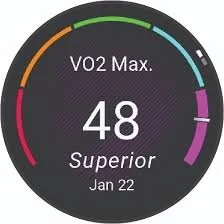
The garmin VO2 max predicator can be highly variable
Your Garmin watch gives you an estimate of your VO2 Max the accuracy is quite variable, we’ve seen a few that are very close and others that are 15-20ml out.
Watch algorithms use speed and heart rate to make a "best guess." They cannot measure how much oxygen you are actually extracting from the air.
At Total Endurance, we use gold-standard gas analysis (the mask setup you see in pro labs) to measure your exact numbers.
We measure your True VO2 Max (Your Ceiling).
We measure your Thresholds (Your Sustainable Speed).
We identify if your engine is the limiter, or if you need to work on efficiency.
But It’s Not Everything
Here’s where a lot of people get lost: VO2 max isn’t a performance predictor on its own. It’s a snapshot of your aerobic ceiling – what’s possible. But it doesn’t tell you how close you can get to that ceiling over time, which is where things like:
Lactate threshold
Functional Threshold Power (FTP)
Training consistency and fatigue management
…all come into play.
You can have a VO₂ max of 70 and still get beaten in a race by someone with a VO2 max of 60 especially as the distance increase and efficiency becomes a more important factor.
Why VO2 Max Still Matters
That said, VO₂ max does give you a useful benchmark:
It shows how much headroom you’ve got for aerobic development.
It can guide intensity zones (especially for high-end intervals).
And when paired with other metrics – like lactate or threshold testing – it helps us build a full picture of where your engine’s strong and where it’s leaking energy.
Plus, it’s trainable – to a point.

So, Should You Test It?
Absolutely – but do it in the right context.
We test VO2 max not just to give people a shiny number to compare with their mates, but to:
See where your ceiling is.
Understand how your body fuels effort (fats vs carbs).
Build better training zones.
Compare progress over time.
And when paired with lactate testing or a run/cycle economy test, it gives a really powerful window into what to train next – rather than guessing or blindly following a generic plan.
Final Thoughts
VO₂ max isn’t the be-all and end-all of endurance performance. But it’s a solid piece of the puzzle. If you understand what it is – and more importantly, how to use it – it can guide your training, help you race smarter, and ultimately get more out of the time you spend sweating.
And that’s what good coaching’s about – helping you train with purpose, not just numbers.
Want to Know Your Numbers?
At Total Endurance, we don’t just test VO₂ max in isolation. We offer a full range of physiological tests designed to give you a proper understanding of how your body performs – not just what a training plan says you should be doing.
Depending on your goals, we can assess:
VO2 Max – your aerobic ceiling.
Lactate Threshold – how long you can work before fatigue builds.
Fat vs Carbohydrate Utilisation – are you burning the right fuel for your race intensity?
Running Economy / Cycling Efficiency – how much energy it takes to move at a given pace or power.
Resting Metabolic Rate – a baseline to support fuelling and recovery.
Whether you're preparing for a triathlon, a marathon, or just want to get more from your training, these tests give us the insight to personalise your plan and remove the guesswork.