

How Understanding My RMR Improved My Training Consistency
Over the last few months, I’ve been diving deeper into my own physiology — specifically my Resting Metabolic Rate (RMR).
As a coach, I know how essential correct fueling is, especially when training for a sport as demanding as triathlon. That’s even more important when you’re also trying to reduce body weight back towards an optimal performance level.
Yet despite knowing all this, I found myself stuck in an odd cycle:
good weeks followed by bad ones
strong sessions followed by unexplained fatigue
training momentum constantly interrupted
It felt like something wasn’t quite matching up.
This blog explains what I discovered when I looked more closely at my own energy requirements, what RMR numbers actually mean, and why understanding your true daily energy needs might be the missing piece in your training — whether you’re an endurance athlete, a parent of a young swimmer, or someone who keeps falling into the exact same “inconsistent weeks” pattern.
To understand what was really going on, I first needed to revisit the fundamentals of how much energy the body actually requires each day.
The Invisible Problem I Didn’t Realise I Had
Like most people, I blamed inconsistency on the obvious culprits:
long days coaching
running Total Endurance
trying to rebuild my fitness from the ground up
general life stress
Nothing unusual.
But a pattern started to appear.
On days when I pushed intensity, or had a packed coaching schedule, I could get through the day… but the next morning I would wake up feeling flat, drained, and fighting to maintain momentum.
The fatigue didn’t feel like a fitness issue it felt like low energy availability.
That was the point where I realised I needed to understand what was really going on with my fueling.
So I decided to look more deeply into my nutrition, understand what I truly needed to be eating, and use my own RMR data to guide how I fuel, train, recover, and build consistency.
What Is Resting Metabolic Rate (RMR)?
Resting Metabolic Rate (RMR) is the amount of energy your body needs to stay alive and functioning at rest.
It accounts for the majority of your daily calorie needs and supports:
organ function
breathing and circulation
muscle repair
digestion
hormone regulation
immune function
basic movement and cognitive demands
Before you lift a weight, run a mile, or even take a coaching session, your body already has a baseline energy cost just to operate.
RMR = your daily minimum requirement.
Any exercises, lifestyle movement, work demands all get added on top of this.
Once you understand what RMR represents, the next step is comparing what your RMR should be versus what it actually is.
Predicted vs actual RMR
The predicted RMR is taken from a well used equation (Mifflin-St-Jeor) and serves as a good benchmark to compare expected vs actual. My RMR was 1584 Kcal per day compared with the predicted 1735 Kcal.
When we see the RMR value being lower than the predicted RMR it can often indicate that the your metabolism may be suppressed due to low energy availability (LEA).
Once i had calculated my resting metabolic rate i started using the myfitnesspal app to track what i had generally been eating in a normal day. Once i started tracking i was on average consuming around 1800-2100 Kcal which when looked at at face value sounds like it would be enough based on the RMR i measured, but remember that RMR is the minimum my body needs to function, so when we start to factor in some exercise or a day where i have higher energy output e.g. a one hour turbo session which will burn ~500kcal. It shows i was barely consuming enough fuel to maintain my RMR.
My body simply wasn’t being provided with enough energy to match the demands being placed on it and due to extended periods of under fueling my metabolism was being suppressed further. So instead of increasing or sitting at a healthy baseline, my RMR being lower than predicted raised a red flag, and it aligned with symptoms often seen in athletes who are under-fuelling.
Reduced Energy Deficiency in Sport (RED-S)
If you eat consistently below what your body needs, even unintentionally, your physiology adapts by becoming more “efficient” at rest. That might sound like a positive thing, but for athletes, it isn’t.
A suppressed RMR means:
reduced energy available for recovery
reduced energy available for training
impaired hormone function
higher fatigue
lower training consistency
increased injury risk
plateaued performance
difficulty losing weight despite eating “less”
Irritability and mood changes
Difficulty focusing
Low motivation
This is the body’s survival mechanism: When energy availability is low, it reduces the cost of running the system.
For athletes trying to train progressively, this is the opposite of what you want.
And when your baseline energy output drops, everything on top of that training, recovery, daily movement, coaching, general life tasks becomes harder to sustain.
This explained the pattern I was seeing:
strong session → next day completely flat
good week → suddenly a bad one without warning
inconsistent recovery
unpredictable energy levels
Struggling to maintain focus on tasks
The issue wasn’t motivation or fitness. It was under-fueling, and my RMR data exposed it clearly.
To address the issue properly, I needed to understand not just my minimum requirements, but my total daily energy needs.
Calculating Total Daily Energy Expenditure (TDEE)
Now knowing i wasn’t eating enough i calculated out what my Total Daily energy expenditure looked for the different training types i am likely to be doing, from days where i am fairly sedentary and not doing training, a day of light training (30-60 minutes easy endurance session), Standard training sessions where i include some intensity and days where i want to do two session in the same day.
This gives me a good range of 1900 kcal/day to ~3200 kcal/day and it matched what i had felt first hand, i was eating enough if i was going to be sitting down most of the day but 500-600 calories short on days where i was trying to train easy up to 60 minutes so its no wonder i kept hitting this wall of fatigue after a couple of days of training.
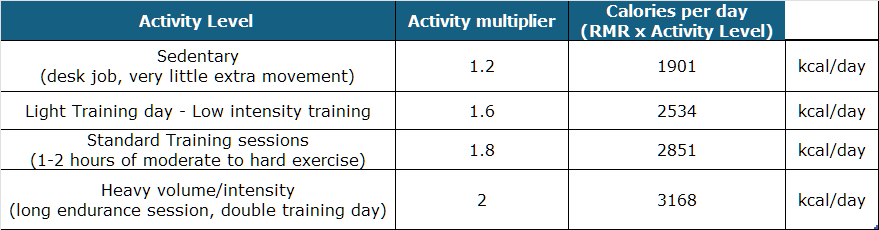
Daily energy requirements based on different training scenarios
Alongside understanding total energy needs, the RMR test also gives useful information about how your body uses different fuels at rest.
Resting Fuel Utilisation
From the RMR data, as we are measuring the amount of oxygen (O2) my body is consuming as well as the amount of carbon dioxide (CO2) my body is producing at rest we can get an understanding of the energy substrate my body is relying on to provide the energy at test. This is called Respiratory Exchange Ratio (RER) and relates to the fraction of O2/CO2. when the RER is 0.7 the body has a higher O2 usage than CO2 being produced indicating that the energy is coming from fat. when RER reaches 1.0 this indicates that carbohydrates are providing 100% of the energy. We will usually see this happen in a VO2 max test but it should never get to 1.0 at rest.
The RER values then scale between 0.7 and 1.0. with 0.85 indicating 50:50 energy contribution.
From me the RER was 0.81 indicating ~63% fat and 37% carbohydrates which indicates my body has good metabolic flexibility and it is reasonably efficient at using fat at low intensity.
Data only becomes useful when it turns into action, so the next step was using these numbers to set my daily calorie and macronutrient goals.
How This Translates Into Daily Fuel Targets
Using my measured RMR and the estimated energy cost of different training days, I created clear daily fueling targets. This gives me a structure to follow so I can support training consistently without under-eating.
On a low-movement day, I need around 1,900 kcal, with 174 g protein, roughly 25% of calories from fat, and the remainder (~140 g) from carbohydrate.
On a light training day, that increases to around 2,530 kcal, with the same protein target, slightly more fat, and around 300 g of carbohydrate.
On a standard training day, I require around 2,850 kcal, which includes 380 g of carbohydrate to support moderate intensity work.
On heavy-volume or double-session days, I need upwards of 3,160+ kcal, with carbohydrates rising to ~460 g to maintain energy availability and support recovery.

Understanding my RMR has given me clarity around why some training weeks felt solid while others fell apart. When I match my intake to the physiological demands of each day, everything becomes more predictable:
energy levels stabilise
recovery improves
training quality rises
consistency becomes achievable
This is ultimately what endurance athletes need most — not bigger sessions, but a foundation that allows them to show up repeatedly and absorb training week after week.
Your body can only adapt to the training you can fuel.
If you want the same clarity around your own energy needs, our RMR testing gives you:
your precise baseline requirement
a personalised framework for fuelling
clarity to avoid under-fueling
support for sustainable progress
a more consistent, predictable training week
If you’d like to understand your RMR and build a smarter approach to fuelling, training, and long-term health, click below to learn more: