

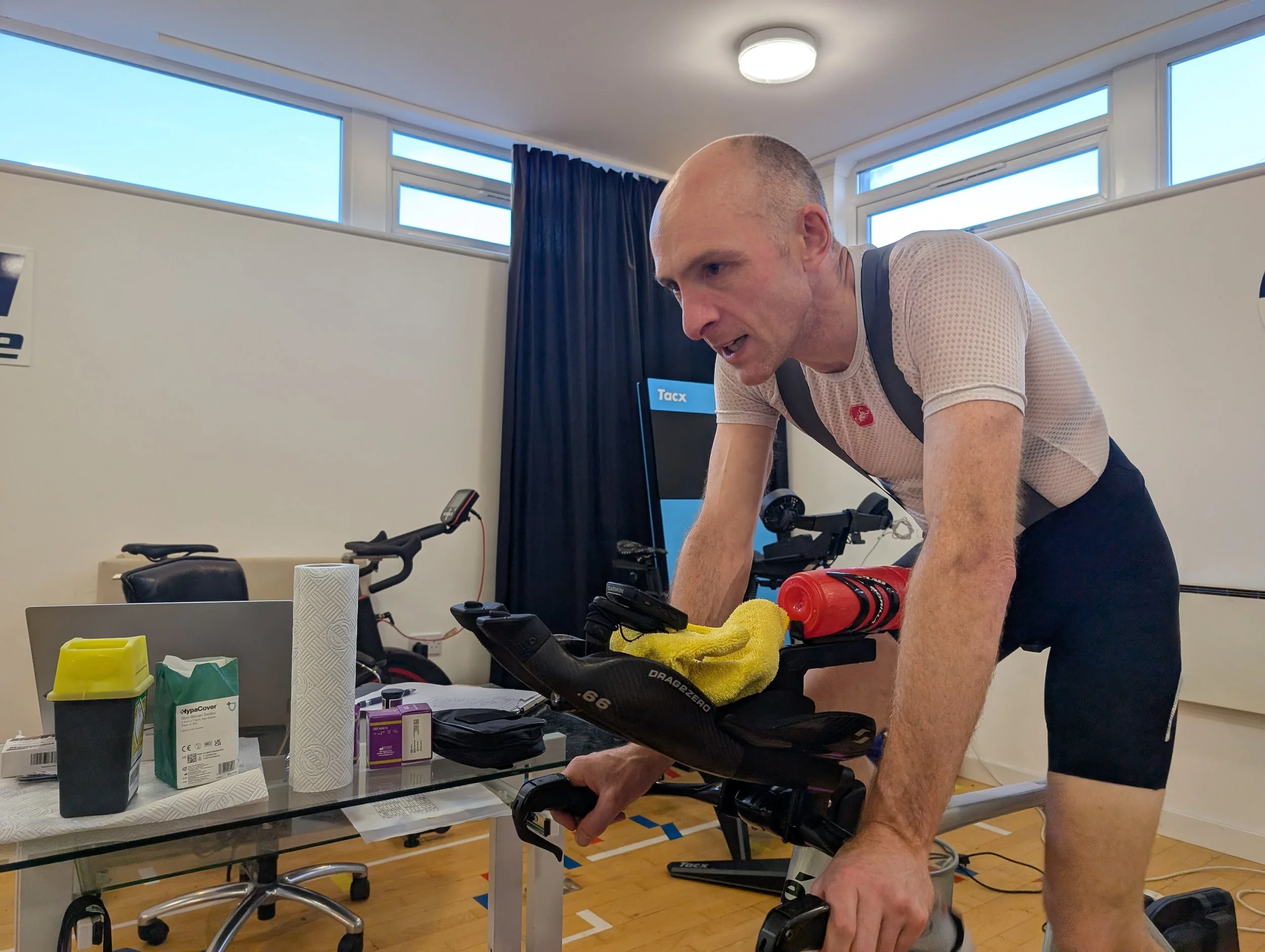
The process
Test. Train with precision. Retest. See the proof.
Full INSCYD metabolic test
VO2 Max, VLamax, MLSS, and FatMax measured precisely — not estimated. Kevin walks you through your results immediately after your session, in plain English.
Your limiter identified, your plan built
Every athlete's data tells a different story. Some have an aerobic ceiling. Some clear lactate slowly. Some have excellent economy but poor fuel utilisation. Your 12-week plan is built around your specific limiter — not a generic template.
12 weeks of targeted training
Every session in your plan ties back to your test data. The intensities, the durations, the type of work — all of it prescribed because it addresses exactly what's holding you back.
Retest and proof
At 12 weeks, you test again. We compare your before and after data directly — and show you exactly what adapted. Not "do you feel fitter." Proof.
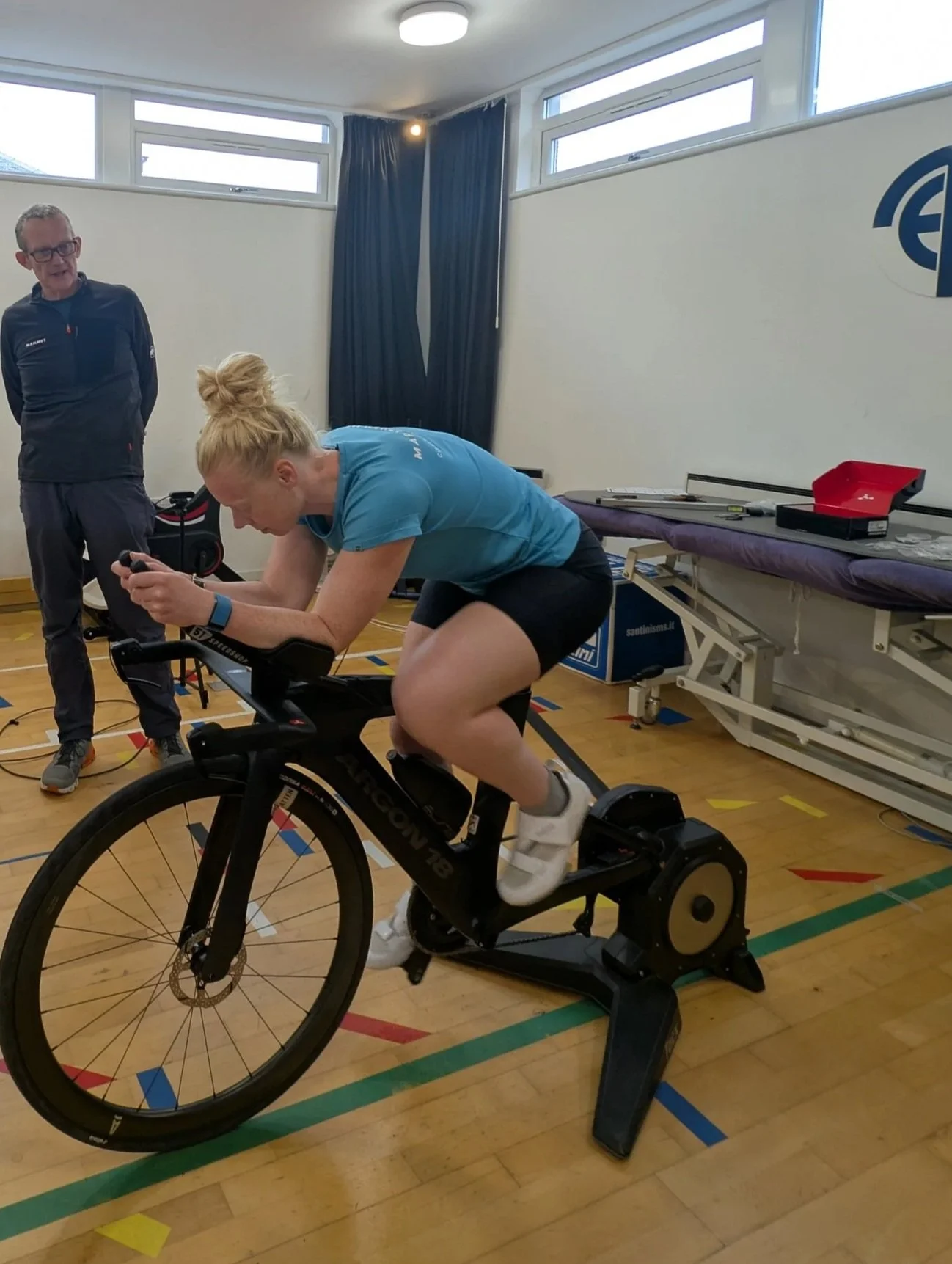
Real results — age-group triathlete, Aberdeen
Her aerobic engine was exceptional. The problem was she couldn't access it on the bike.
"The data didn't tell us she needed more fitness. It told us exactly why she couldn't use the fitness she already had."
Nicole Campbell came to us with strong run physiology — a running VO2 Max above 62 ml/kg/min, placing her well above average for her age group. But her cycling performance didn't reflect that aerobic capacity at all. Her initial INSCYD cycling test told us exactly why: her bike-specific muscular strength wasn't developed enough to access the aerobic engine she'd built through running. She had the engine. She just couldn't get to it on the bike.
The diagnosis — Test 1, January 2026
A strong aerobic system. A cycling threshold that couldn't reach it.
Nicole's run VO2 Max exceeded 62 ml/kg/min — an exceptional aerobic ceiling. Her cycling VO2 Max came in at 43.96 ml/kg/min — a significant gap that wasn't about fitness. It was about bike-specific muscular capacity. The data told us where to focus: not more aerobic work, but longer sustained intervals to build the cycling-specific strength needed to translate her aerobic fitness into power at the pedals.
Test 1 — January 2026
Test 2 — May 2026 (4 months later)
What changed — in 4 months of targeted training
Cycling VO2 Max
+8.46 ml/kg/min more aerobic capacity accessed on the bikeThreshold power
+45W 180W → 225W — 25% more usable power at race paceVLamax
−0.09 lower lactate production — more efficient at every intensityFat oxidation
+9 kcal/h — burning more fat, sparing carbohydrate at race paceThe improvement wasn't random and it wasn't generic fitness gains. The data from Test 1 told us precisely what was limiting Nicole's cycling performance — not her aerobic system, which was already strong, but her ability to access it on the bike. The 12-week block targeted exactly that: longer sustained intervals to build cycling-specific muscular strength. Four months later, the retest proved it worked. Her cycling VO2 Max increased by 8.46 ml/kg/min — not because her aerobic ceiling rose, but because she could finally reach more of it. Her threshold power jumped 45 watts. Her VLamax dropped, meaning she now produces less lactate at every intensity. She burns more fat and less carbohydrate at race pace — meaning she arrives at the run with more energy in reserve.
Every one of those improvements was predicted by the Test 1 data. Every one was confirmed by Test 2. That's what the Endurance Performance Project is designed to do.
This isn't a fitness test. It's a diagnosis, a prescription, and the re-test proved the training that the prescribed training worked.
Choose your package
Single sport or multisport — both include the full programme
Every Endurance Performance Project includes the same structure — test, purpose-built plan, retest, coach review. The only difference is how many disciplines we test.
Endurance Performance Project
Test. Train with precision. Retest. See the proof.
Every package includes
- Full INSCYD metabolic profile
- Post-test review immediately after your session
- Full written report within 48 hours
- Optional data consultation once report received
- Purpose-built 12-week training plan
- Every session tied to your specific physiology
- Retest at 12 weeks
- Before and after comparison report
- Coach review — proof of what adapted
How it works
- Test 1 — establish your baseline
- Your specific limiter identified
- 12-week plan built from your data
- Test 2 — measure exactly what changed
- Coach review — your before and after, explained
- Optional next step: TEP coaching
Not sure which is right for you? Get in touch and we'll point you the right way.
Common questions
Before you book
Isn't this just an expensive way to test twice?
No — the value isn't the second test, it's everything between the two tests. Anyone can retest. The Endurance Performance Project is the test, the targeted 12-week plan built specifically from your data, and a coach review that explains exactly what changed and why. The two tests are the proof, not the product.
What if my numbers don't improve?
They will move — the question is which direction and by how much, and that itself is valuable information. If a plan built around your specific data doesn't produce the expected adaptation, that tells us something important: There's another factor — recovery, fuelling, life stress — affecting your training. Either way, you leave with more clarity than you started with, not less.
Do I need to already be following structured training?
No. The Endurance Performance Project is often the starting point for athletes who've never trained with real structure before. It's equally valuable whether you're refining an already-serious programme or building one for the first time.
Is this right for me if I'm not chasing a specific time goal?
Yes. Whether your goal is a specific finish time, completing your first Ironman, or simply training without wasting effort on the wrong sessions, the same principle applies — you train better when you know exactly what your body needs.
How is the multisport version different?
Triathletes get both a bike and run INSCYD test, both retested at 12 weeks. Your 12-week plan addresses limiters across both disciplines, since the two are connected — your run economy is affected by what happens on the bike, and vice versa.
What comes after your retest
Most athletes don't stop at proof. They use it.
Once your retest confirms what adapted, the natural next step for many athletes is TEP coaching — taking the same precision approach and applying it to ongoing training, not just a single 12-week block. Your coach review session is where this conversation happens naturally, built directly from your before-and-after data.