

I'd always considered myself a reasonably competent swimmer for triathlon. Around 1:20/100m CSS pace when fit. Comfortable in open water. Usually near the front of the swim in events I've competed in.
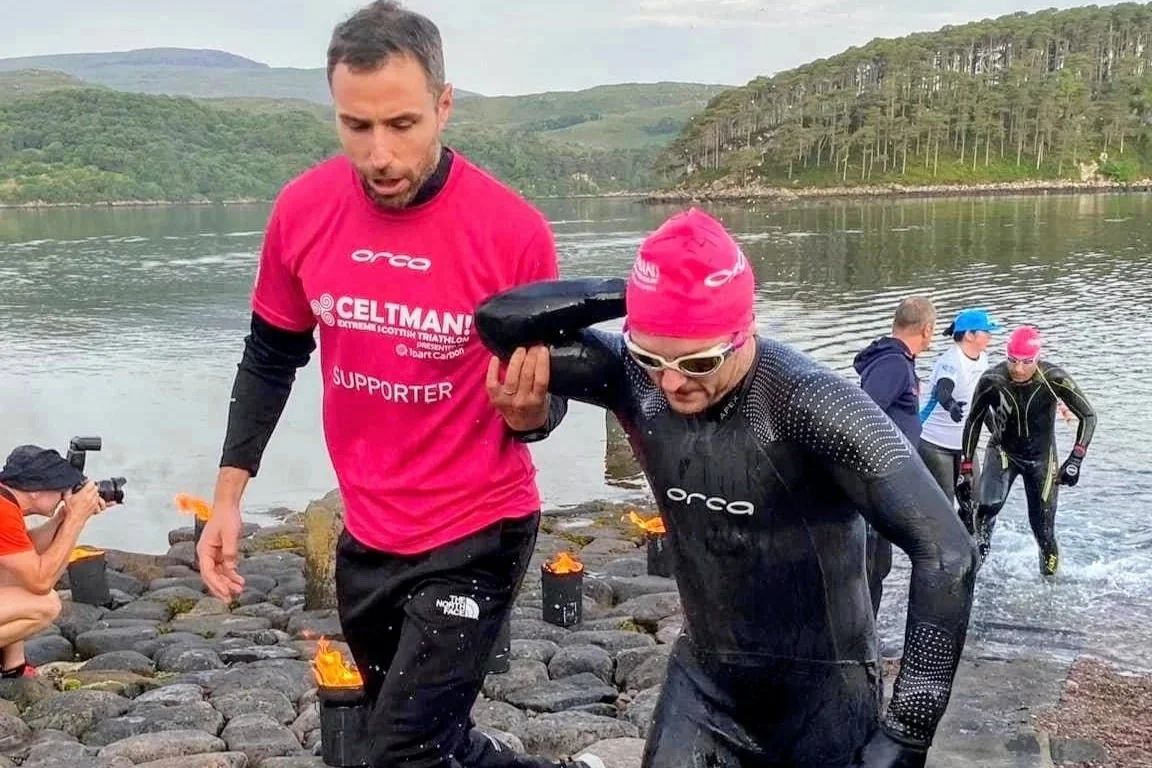
Coming out the Celtman Swim 2nd in 2023 - Held 1:25/100m for the 3200m swim
But swimming has always intrigued me beyond just getting through it, having never been a competitive swimmer, i got into swimming properly when i got into triathlon ~2008. While i was never a complete beginner (first 1500m event i think i swam ~28 minutes) . My interest in coaching actually started here — I wanted to understand why some people move through the water faster than their cycling and running fitness would predict, and why others with exceptional aerobic capacity seem to struggle the moment they hit the water. I'm still on that journey. I believe I have a solid grasp of the fundamentals, but I keep pushing to understand swimming more technically, physiologically, and psychologically. There's a lot of the latter required to keep you swimming up and down a black line for hundreds of meters at a time.
One thing I've come to believe strongly is that traditional swim training is often built on inherited practice. Sets and drills passed down because they've worked — or appeared to work — without always understanding why, or more importantly, for whom. Swimming is an individual sport, but we tend to train it like a team sport. Everyone does the same sets, the same drills, at the same time. And much of the time, we don't really know what's working for each individual and what isn't. We can't see what's happening underwater in any meaningful detail. We prescribe drills without always knowing whether those drills are addressing the actual fault, or whether the fault even exists in that swimmer's stroke to begin with.
This isn't a criticism of coaches or athletes who operate within that system — it's a reflection of how little objective data has traditionally been available. When you can't measure what's actually happening in the water, you default to what's worked before and hope it applies.
But this is also exactly what I enjoy most about coaching — having something concrete to figure out. Actionable problems with measurable solutions. I've come to realise i’m not an athlete who loves training for the sake of it. I deeply admire people who are, but that's not me. If I had to pick dog analogy — I'm probably a Rottweiler. Pretty strong, not stupid, but not blindly obedient. I need to understand something before I'll commit to it, and I'll appear stubborn right up until the point I'm convinced. But once I'm in, I'm relentless and it’ll take a large external force to stop me.
As I'm starting from close to zero in terms of fitness, I'm making a conscious effort to rebuild everything from the ground up. I'm not trying to get back to where I was — I'm trying to be better. As Sha'Carri Richardson said: "I'm not back, I'm better."
Here's what the analysis showed, what it means, and why I think it points toward a better way of understanding and developing swimmers — individually, and with evidence rather than assumption.
What EO SwimBETTER Paddles Actually Measure
Most swim feedback is subjective. A coach watches from the pool deck, gives you a cue, you try to act on it. Underwater video is better — but it still tells you what the stroke looks like, not what it's actually doing in terms of force production.
The EO paddles open up a whole world of data about what's actually happening under the water. Getting an insight to not just how fast I was going, but exactly what my hands were doing in the water on every stroke — where my force was going, how much of it was useful, and where it was being wasted. It removed the guesswork and replaced it with something I could actually act on.
What the data revealed surprised me. Not because the numbers were catastrophic, but because they showed clearly that most of the swim pace I'd built over the years had come from fitness and physical strength — not from good technique. I've likely just been compensating for them well enough that the pace looked reasonable from the outside.
The data breaks down into three directions. Propulsive force is the only one that actually moves you forward — it's the backward press of the hand through the pull phase. Downward force presses water toward the pool floor, which can help body position but contributes nothing to propulsion. Lateral force goes sideways — left or right — and is largely wasted energy.
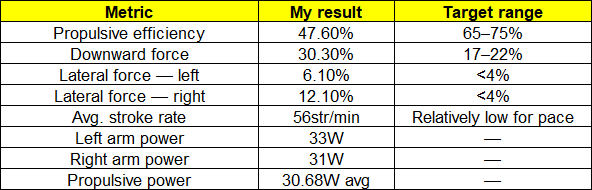
The master metric is propulsive efficiency: the percentage of your total hand force going in the right direction. A strong age-group swimmer typically sits at 65–75%. Elite open-water swimmers reach 75–80%.
I was at 47.%.
The Numbers From My Session
The test was three minutes in the endless pool at 1:30/100m. Not a sprint, but not easy either.
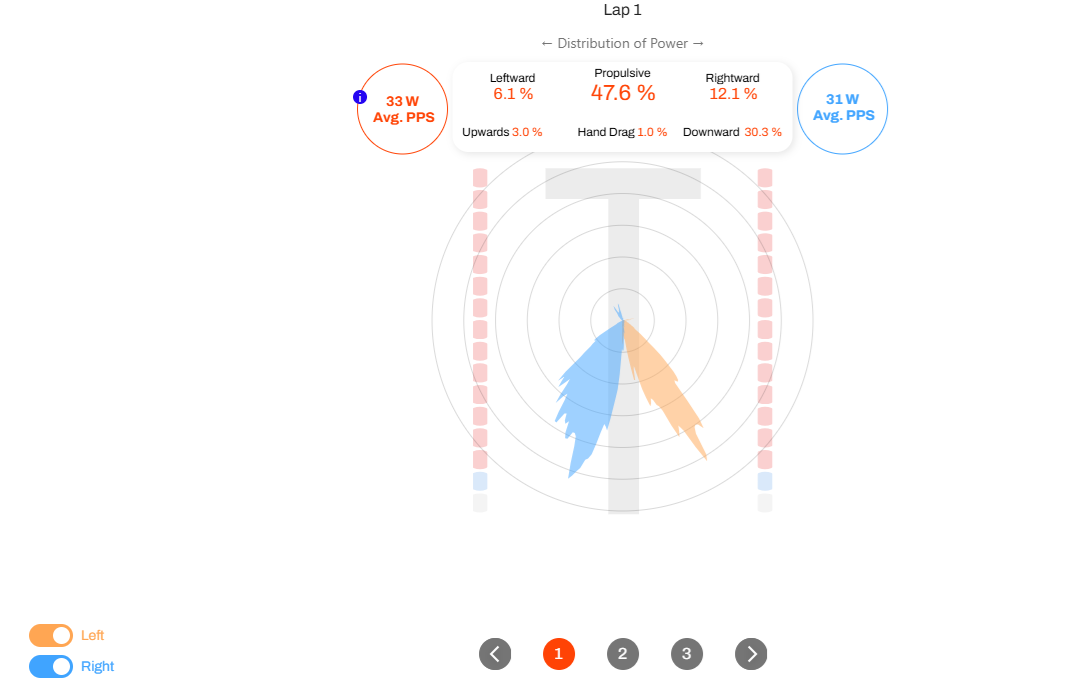
Force field data from my EO SwimBETTER session. Propulsive 47.%, Downward 30.3%, Rightward 12.1%. The target propulsive range is suggested ~65–75%.
The headline numbers from the session:
47% Propulsive Efficiency — What That Actually Means
The most important implication isn't that I'm slow — it's that there's significant pace available without any additional fitness. If I can redirect more of my hand force backward, I go faster on the same aerobic output. This is a mechanical problem, not a lack of fitness problem. No amount of extra interval training fixes it.
"There's pace available here without any more fitness — and none of it requires swimming harder."
That gap between 47% and even 65% represents my next performance gain. None of it requires swimming harder or getting fitter. It just requires swimming better — which is a very different thing, and one I've never really prioritised.
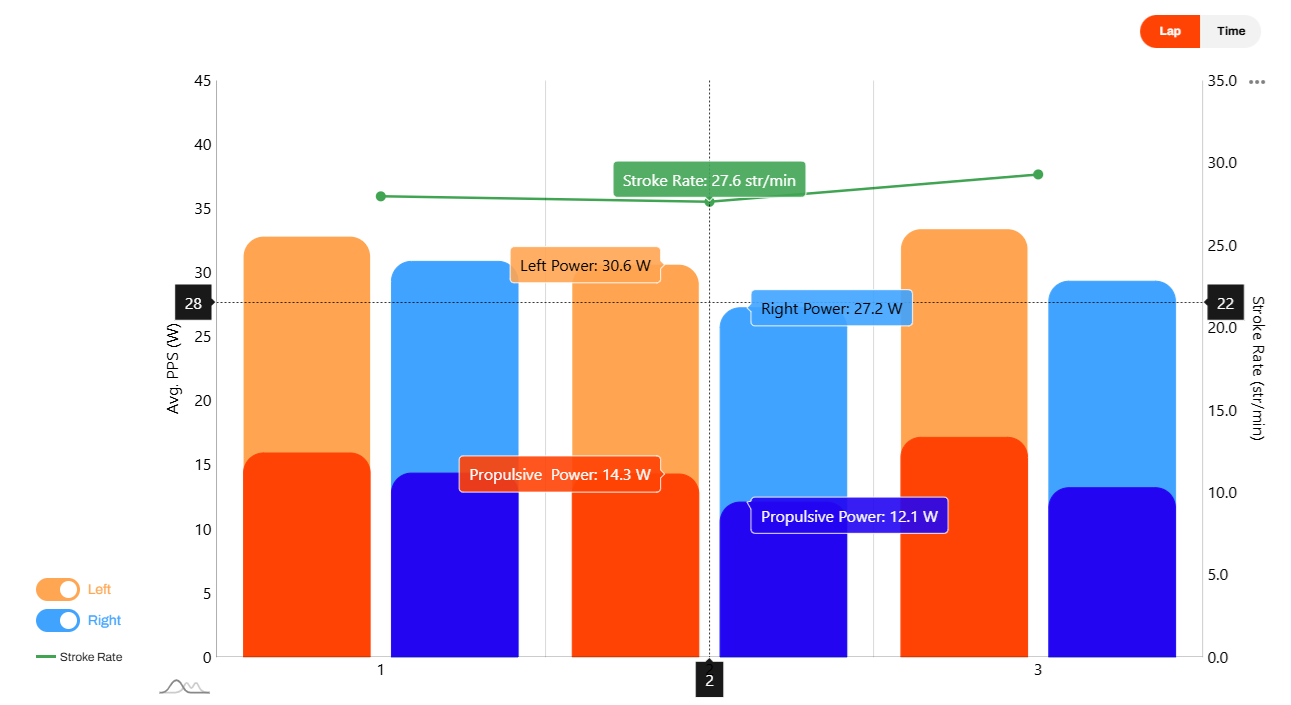
Left arm power (orange) vs right arm power (blue) across 3 minutes. Propulsive power shown in red.
Looking back, the pace I've achieved has come mostly from general strength, good aerobic fitness, and i have very good mobility especially in my shoulders and thoracic which allows me to get slightly better position than someone with similar technique but less mobility. But it tends to suggest i've been brute-forcing swim sessions for years without addressing the fundamental mechanics. The EO data makes that clear — and for someone who needs to understand before they commit, that's exactly the kind of evidence I need to change how I approach this.
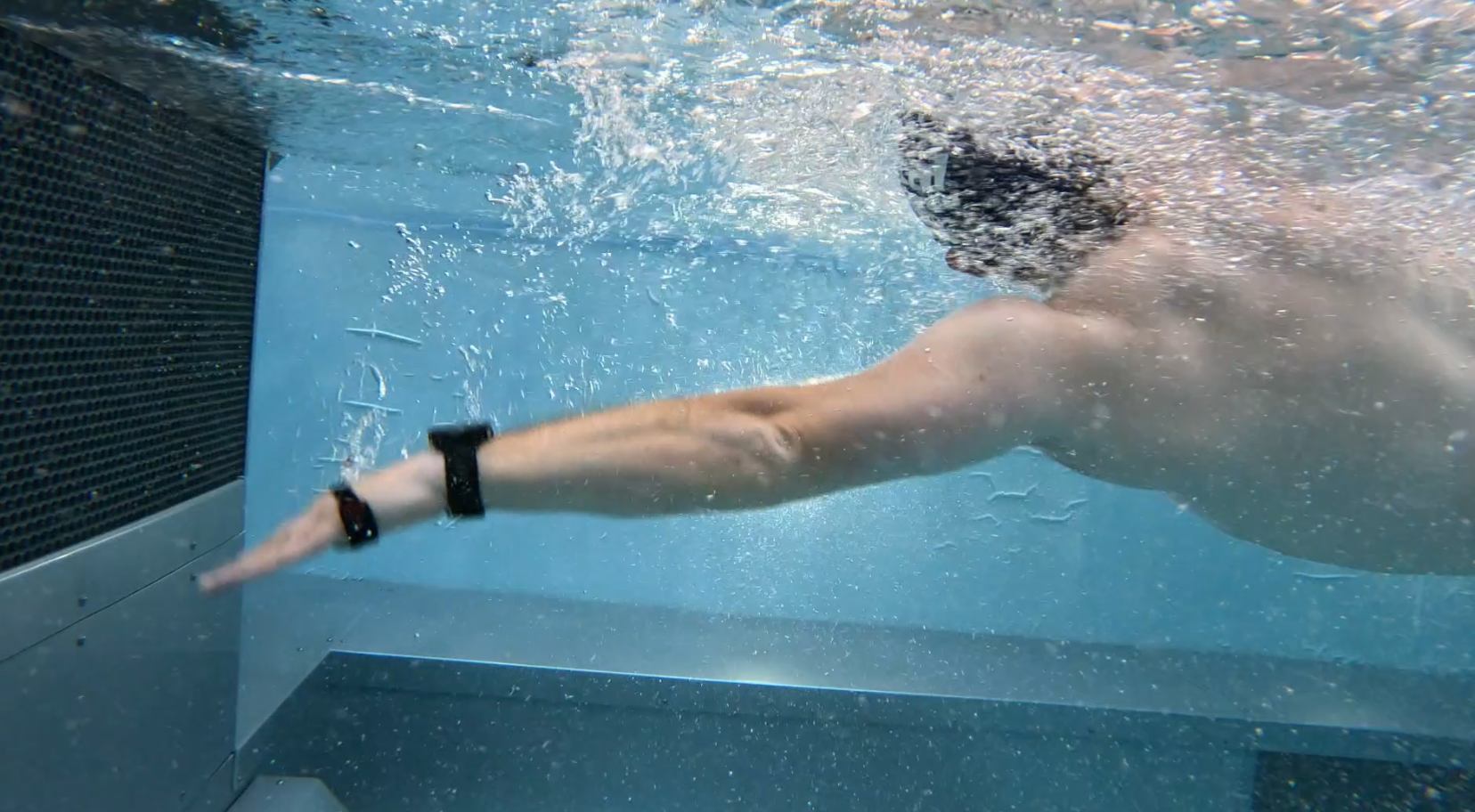
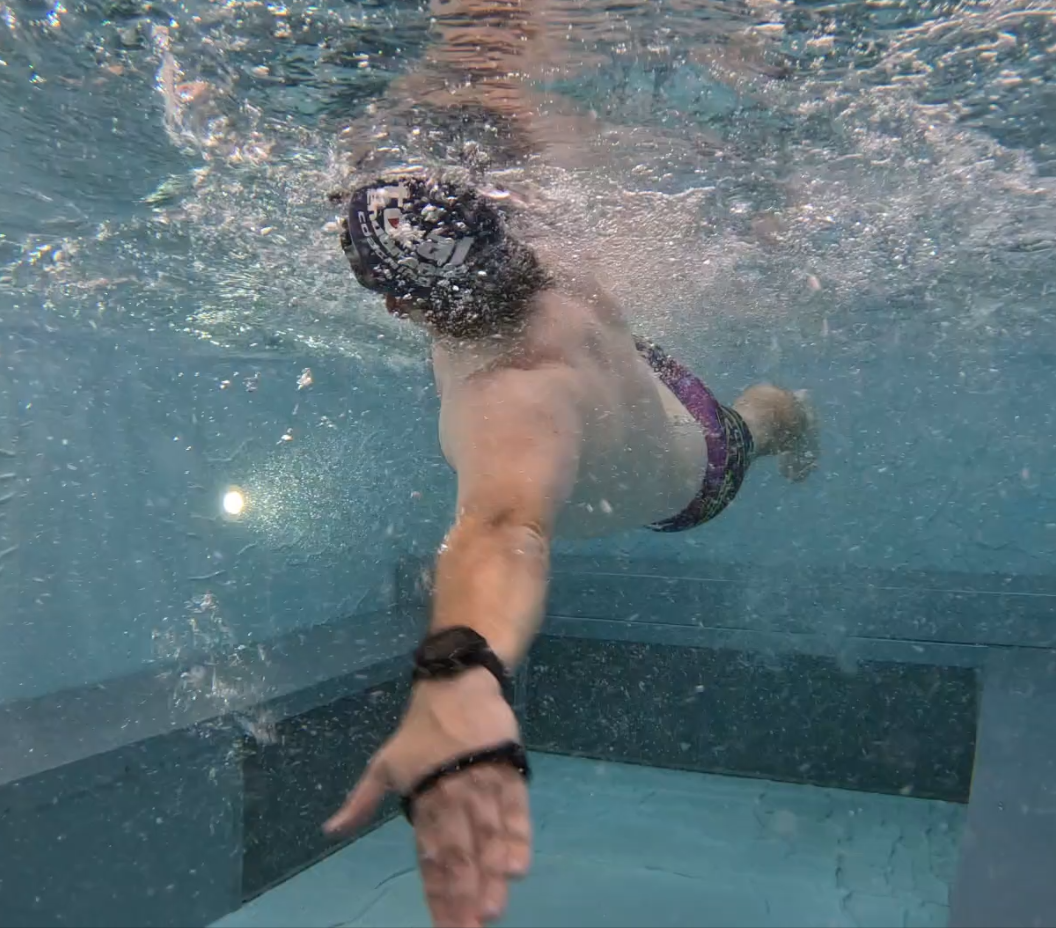
The Dropped-Elbow Catch — Where 30% of My Force Is Going
Nearly a third of my hand force is pressing water downward. That's almost double the upper end of the suggested range.
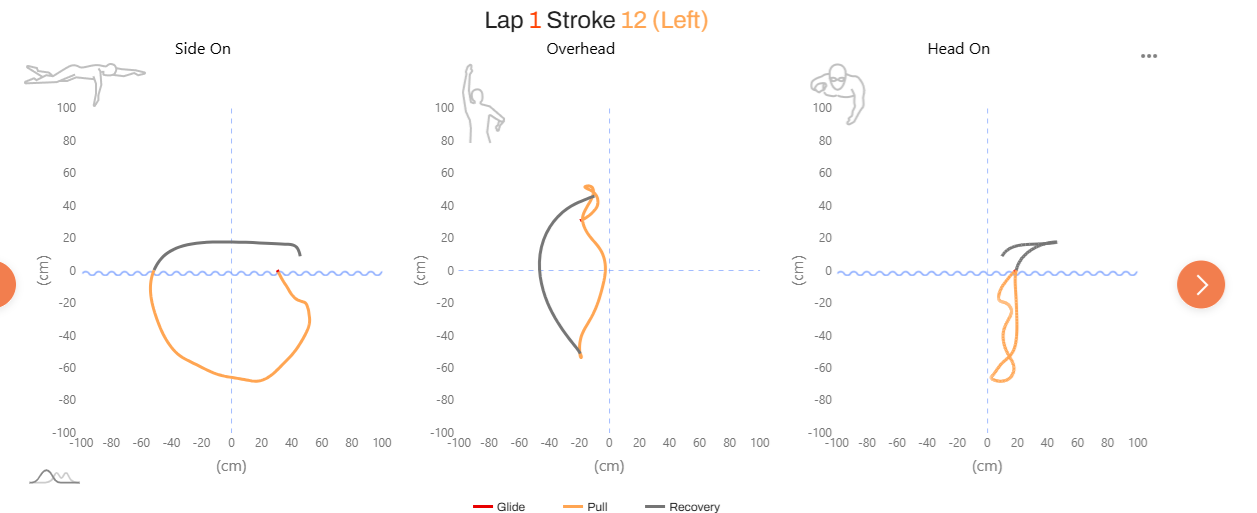
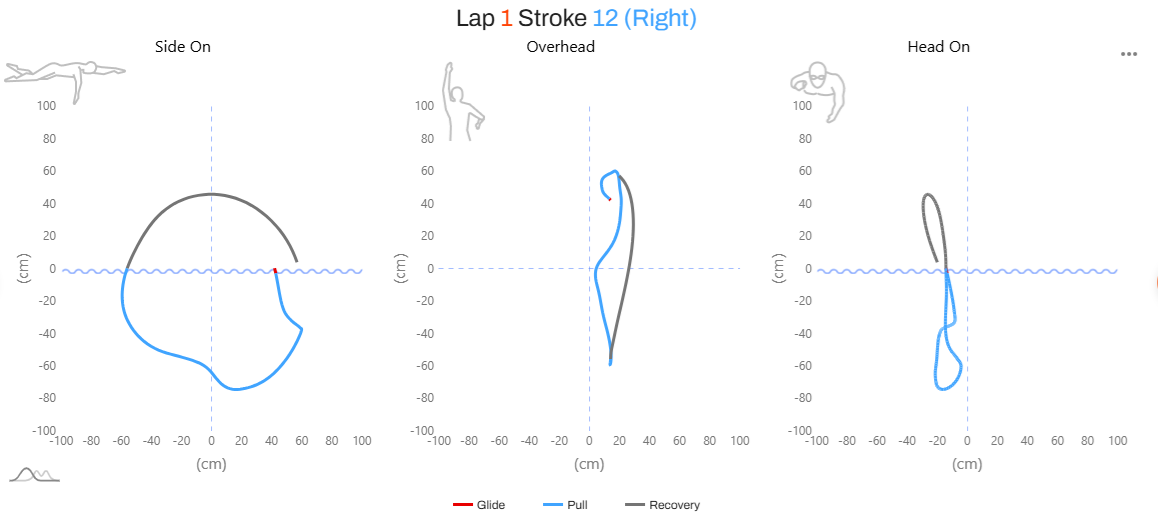
The underwater footage tells a more nuanced story than the data alone. The right arm initiates well at the front of the stroke - elbow is high, there's bend in the arm, the forearm is close to vertical at the point the power starts.
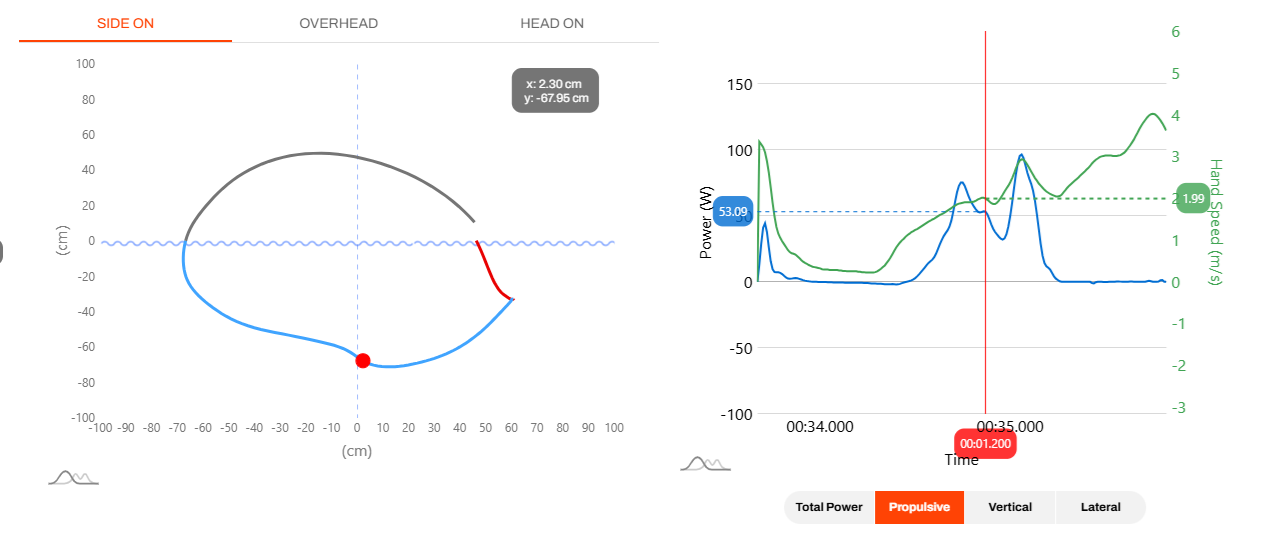
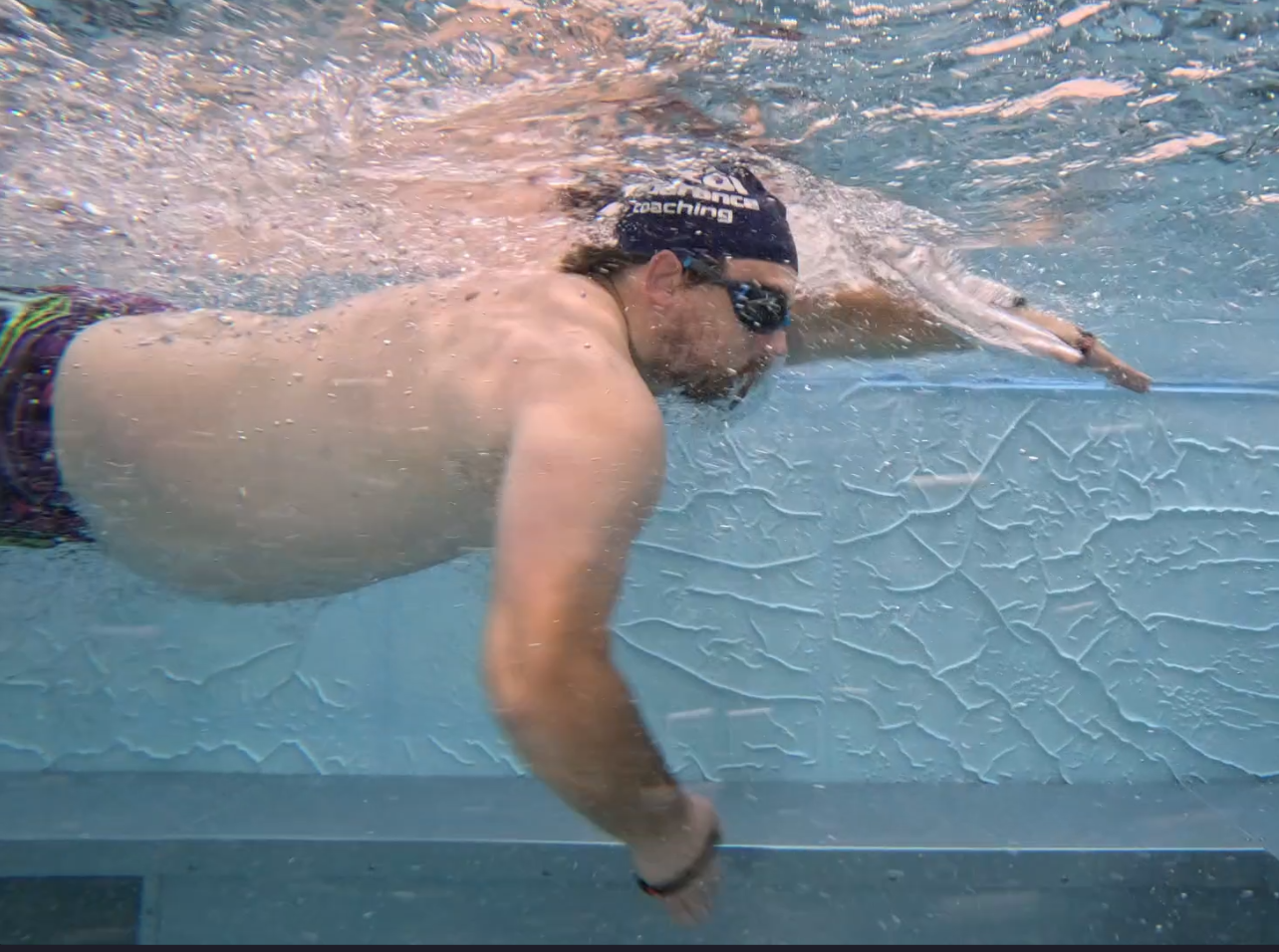
Through the mid part of the stroke, my shoulder rotates - dropping the elbow instead of maintaining the vertical forearm and continuing to press water backward, the arm defaults to an easier path and the push goes diagonally outward toward the hip rather than straight back. I do regain some propulsion (see the rise in the blue line above) - this is something i have focused on in the past (what Scull drill 3 is trying to achieve) but the loss of power is significant and despite the relatively good set and stroke finish, there is a big loss in power at the point where i am generating more power.
In the lead up to Celtman 2023 i was getting a lot of pain in my left shoulder and even on shorter swims i can feel it happen sooner. The left shoulder pain is a consequence of this whole pattern. The left side is carrying compensatory load — when the right arm is dropping through the back half of its pull, the left arm works harder to maintain propulsion through the stroke cycle. Because of this '‘slipping’ instead of turning my hip properly, i rely on my thorax mobility and a twist in the middle. This thorax-hip disconnection means i don’t get much hip drive on the left side, the left shoulder over-rotates through the upper back to generate reach, loading the anterior left shoulder on every entry. Interestingly, my left hip / glutes have always been my weaker side and its usually the side i get issues with when running and i think these are all connected.
What This Means Going Forward
Its likely that my swim performance I've built previously has come from aerobic fitness, general strength, and not from ‘good’ technique. The mechanics have always had significant areas that can be improved but I've been compensating for them well enough that the pace i could maintain was good (relatively speaking)
The opportunity i have now is that as fitness is genuinely right now i can start almost at the beginning and rebuild my stroke (and my running) from the ground up and try to avoid the temptation to just go back to what i was doing before.
When fitness is high, there's a temptation to default to what works — push harder, lean on the engine, get through the session. Technique work takes a back seat because the fitness covers the cracks. Starting from a lower fitness base removes that option. There's nothing to lean on except the stroke itself. That makes now the right time to rebuild from the foundations.
For me, this is the kind of data that excites me, I'm not guessing at what to fix. I know exactly what's wrong, in what order to address it, and what the re-test numbers need to look like. That's the most motivating thing I've had in my own training in a long time and it excites me as what i achieved before might have been me at 50% efficiency. My plan is to Re-test once i’ve gotten back to a couple of sessions per week and track how the numbers change and compare to where i am starting from.
Want to know what your stroke data looks like?
Swim propulsion analysis can help you understand the exact parts of your stroke that’s limiting your improvements and can help diagnose why you get specific pain points.