

A VO2 max of 77, but he can't turn it into speed
Euan has the kind of aerobic engine most athletes dream about. His swim-specific VO2 max is 77.3 ml/kg/min, which puts him firmly in elite territory.
The problem is that he can't convert all that oxygen into speed in the water. That means we can't make him faster just by making him train harder. We have to improve his technical efficiency: how well he turns the oxygen he uses into speed.
This is the story of an athlete who doesn't need a bigger engine. He needs to waste less of the one he already has.
Meet Euan
Euan is a junior elite triathlete. He races a mixture of the British Super Series and is moving more towards elite off-road racing, including XTERRA events.
On paper, his swimming is already good. His 400m freestyle best is 4:27.13 short course (4:28.49 long course), his 1500m best is 17:51.40 short course, and he recently finished second in the 17–24 age group over 4km at the 2026 West District Open Water Championships, in 50:42.89.
Good, but not quite elite. To stay near the front pack in elite triathlon swims, we'd like to see his 400m trending towards sub-4:20.
Right now, Euan can't sustain front-pack pace, and the reason is his efficiency. When he eases off just a little below elite race pace, his stroke works much better and he can hold that speed for a long time. Push him up to the speeds of an elite race start, and his stroke starts leaking power.
So the real question is how we improve him. That's where technique comes in.
How we tested him
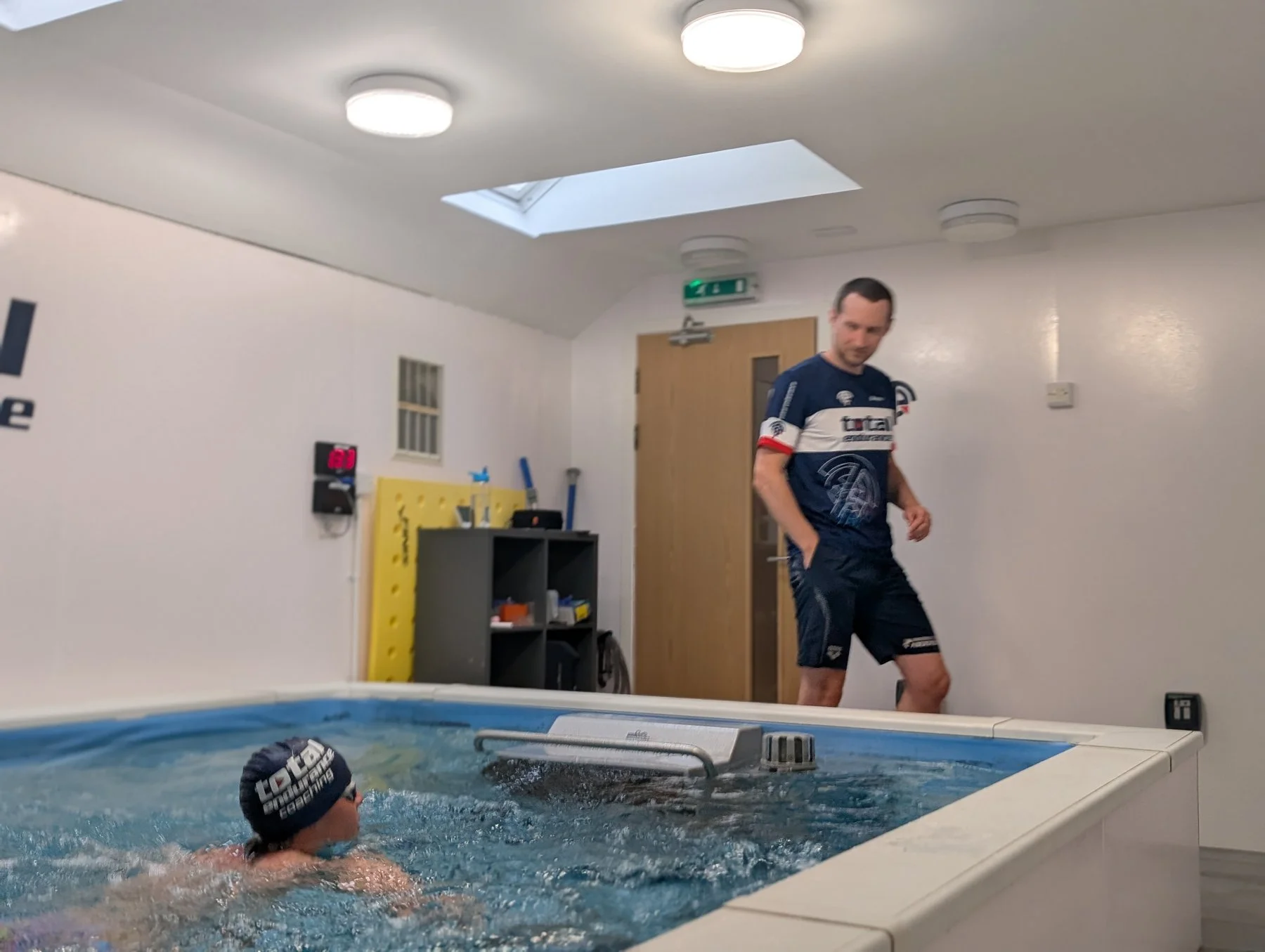
In July we tested Euan, along with a few swimmers from Garioch Swim Team, using our indoor swim testing. He swam 3 × 400m at increasing intensity, then an all-out 300m.
After each effort we took a blood lactate sample and measured his oxygen consumption. We measured his VO2 at the end of each effort and used backward extrapolation to work out the VO2 he was using during the effort itself. He also wore Eo SwimBetter propulsion paddles throughout, which measure the force from each hand on every stroke and the direction it goes in.
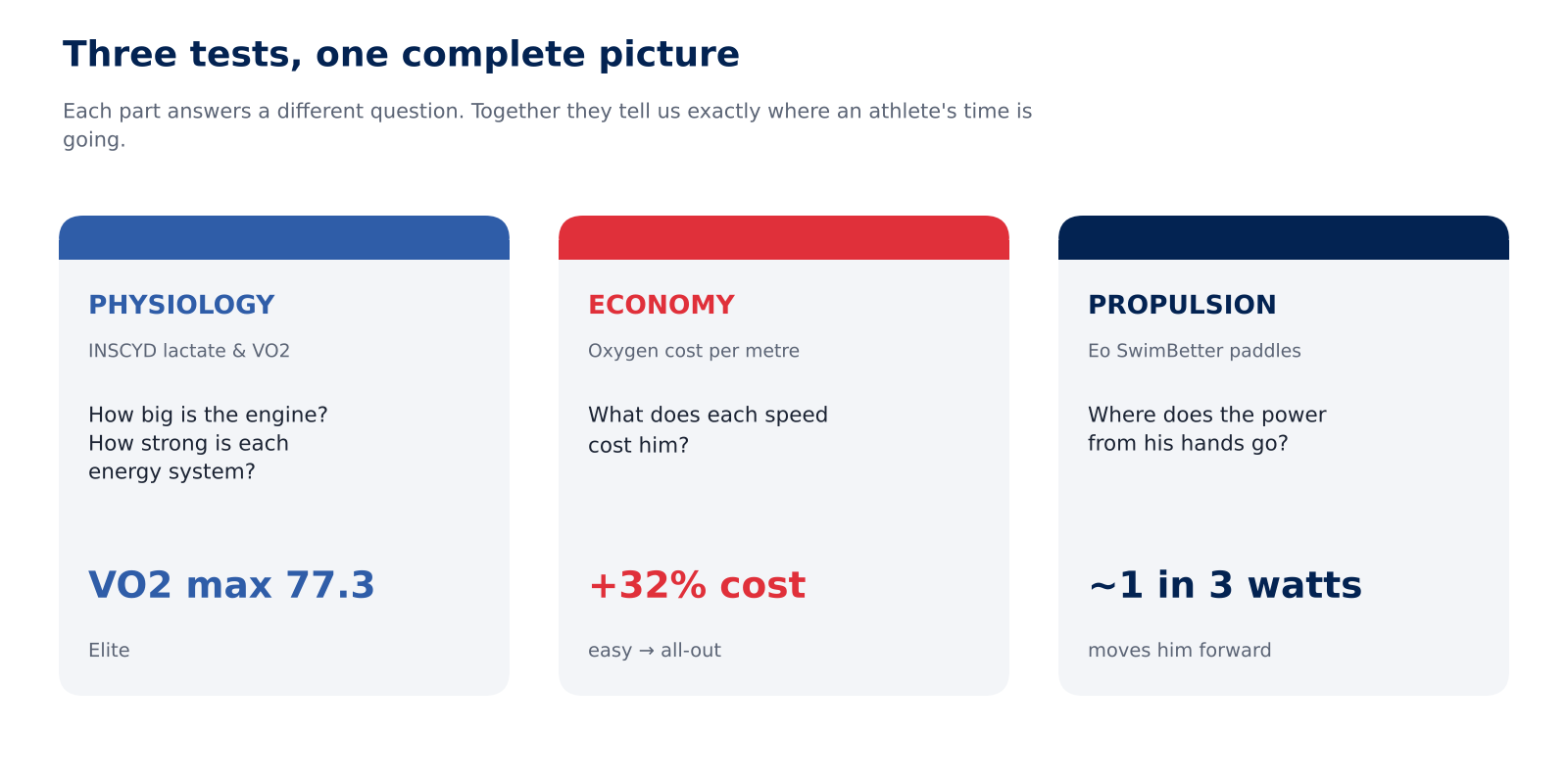
That gives us a complete suite of testing data, covering his physiology, his economy and his propulsion. Once you understand all three, you know exactly where to focus.
The engine: what INSCYD showed
VO2 max: 77.3 ml/kg/min. Elite aerobic capacity.
Threshold (MLSS): 1:12.6 per 100m, at 90% of his VO2 max. He already uses almost all of his engine at threshold.
VLamax: 0.32 mmol/L/s. Low glycolytic power. Great for endurance, but it limits sprinting.
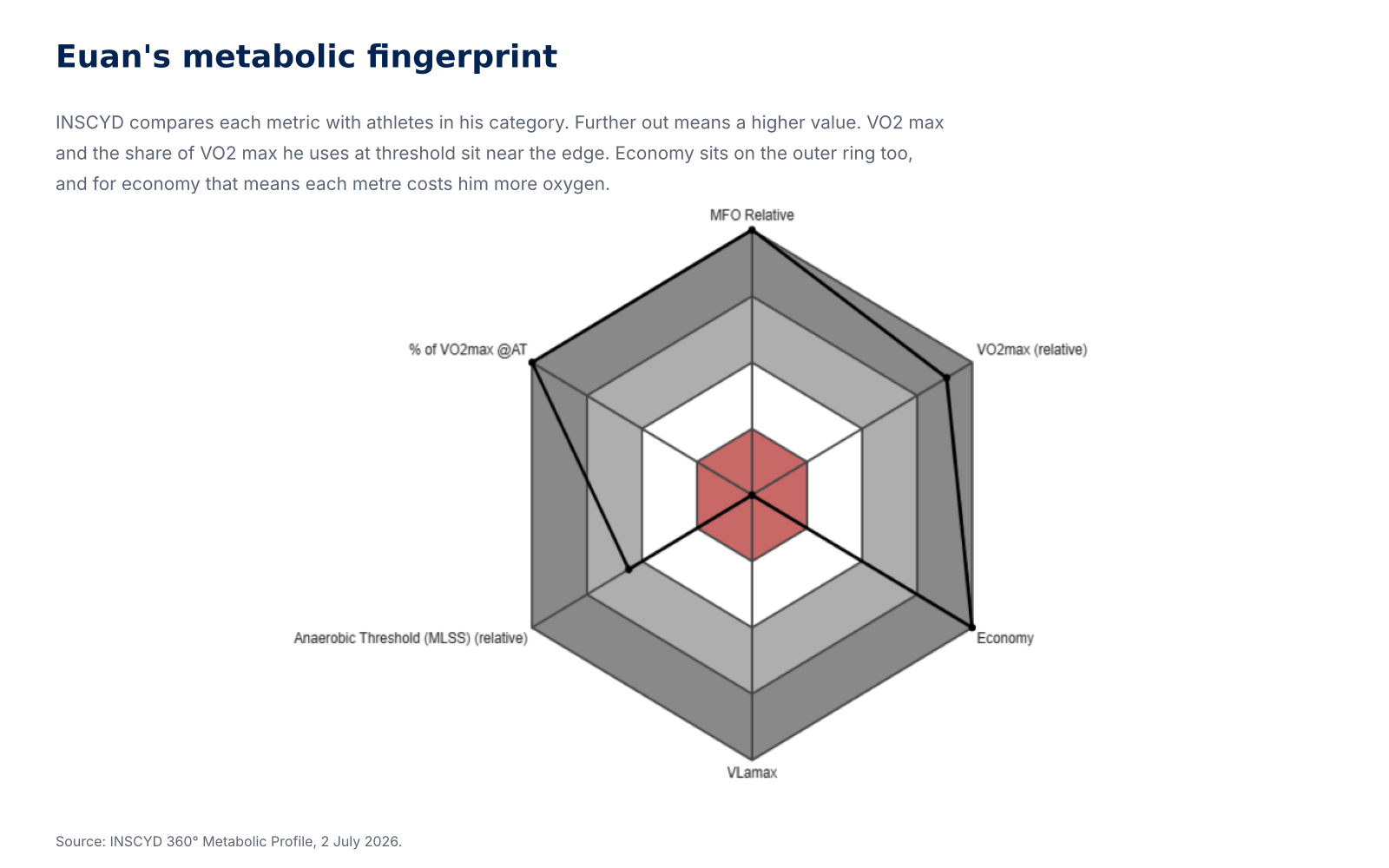
Two things stand out. His threshold is already about as close to his VO2 max as it gets, and his VO2 max is already elite. Fitness is not where his time is.
The other is his economy, which is poor. On his INSCYD metabolic fingerprint, economy means oxygen cost per unit of speed, so a high score means each metre is expensive. Euan's sits right on the outer ring.
The cost of going faster
Here's how much oxygen each metre cost him at each step of the test.
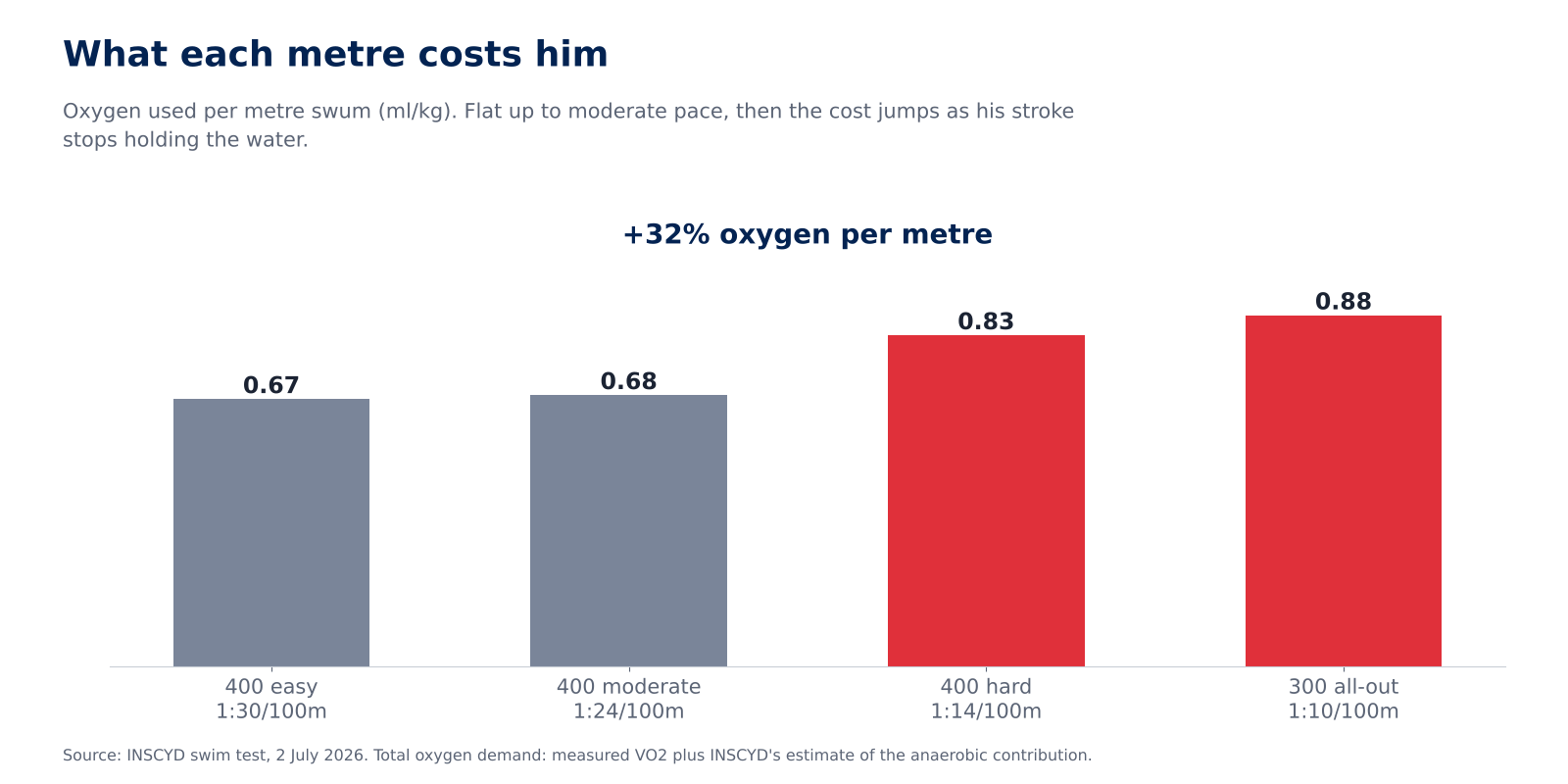
Up to moderate pace, each metre costs Euan the same amount of oxygen. Then the cost jumps: by the all-out 300, every metre costs 32% more oxygen than at easy pace. Some of that rise is normal, because water resistance climbs steeply with speed. The question is why it climbs so much for him. That's where the Eo data comes in.
What reached the water: what Eo showed
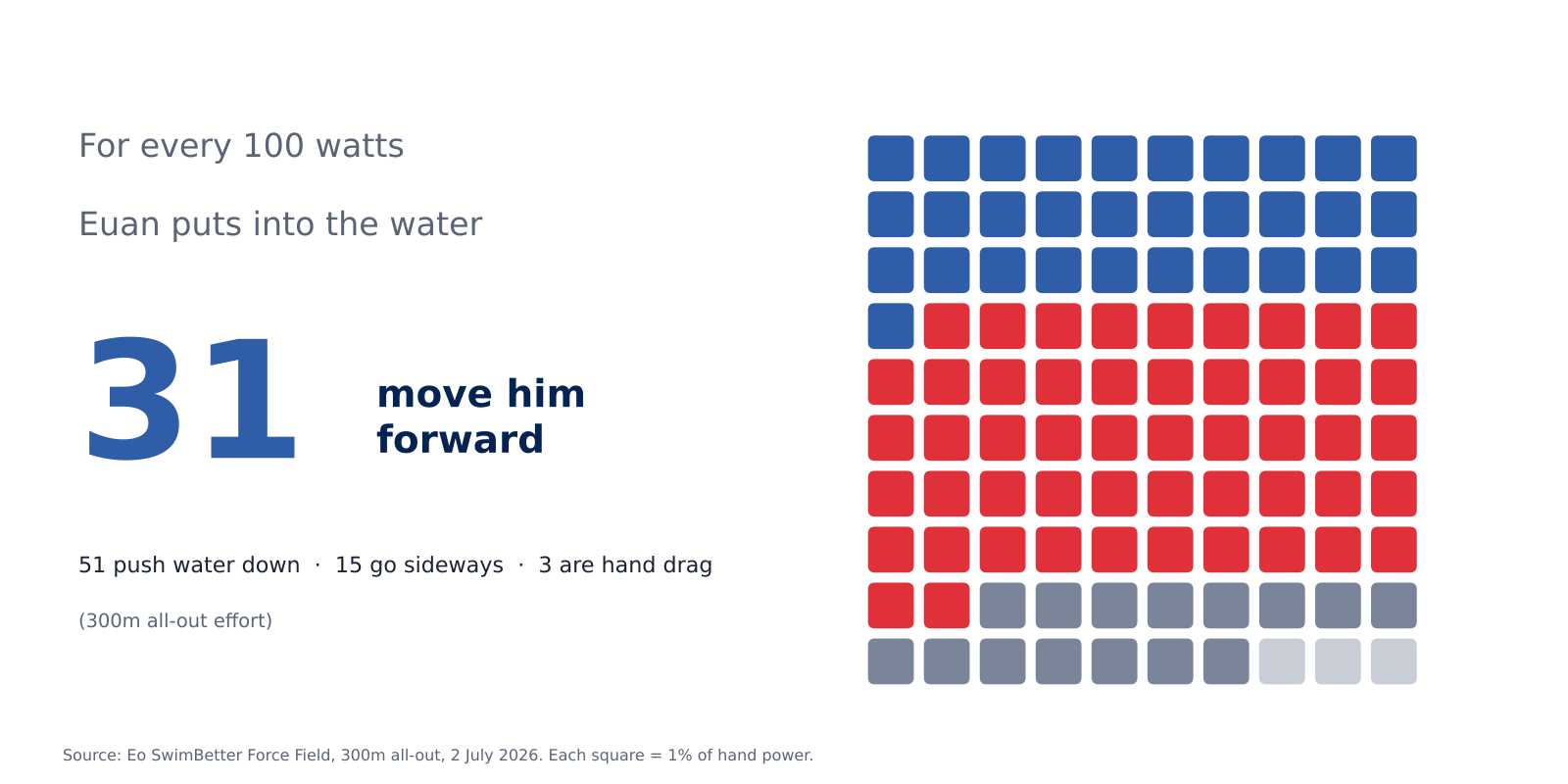
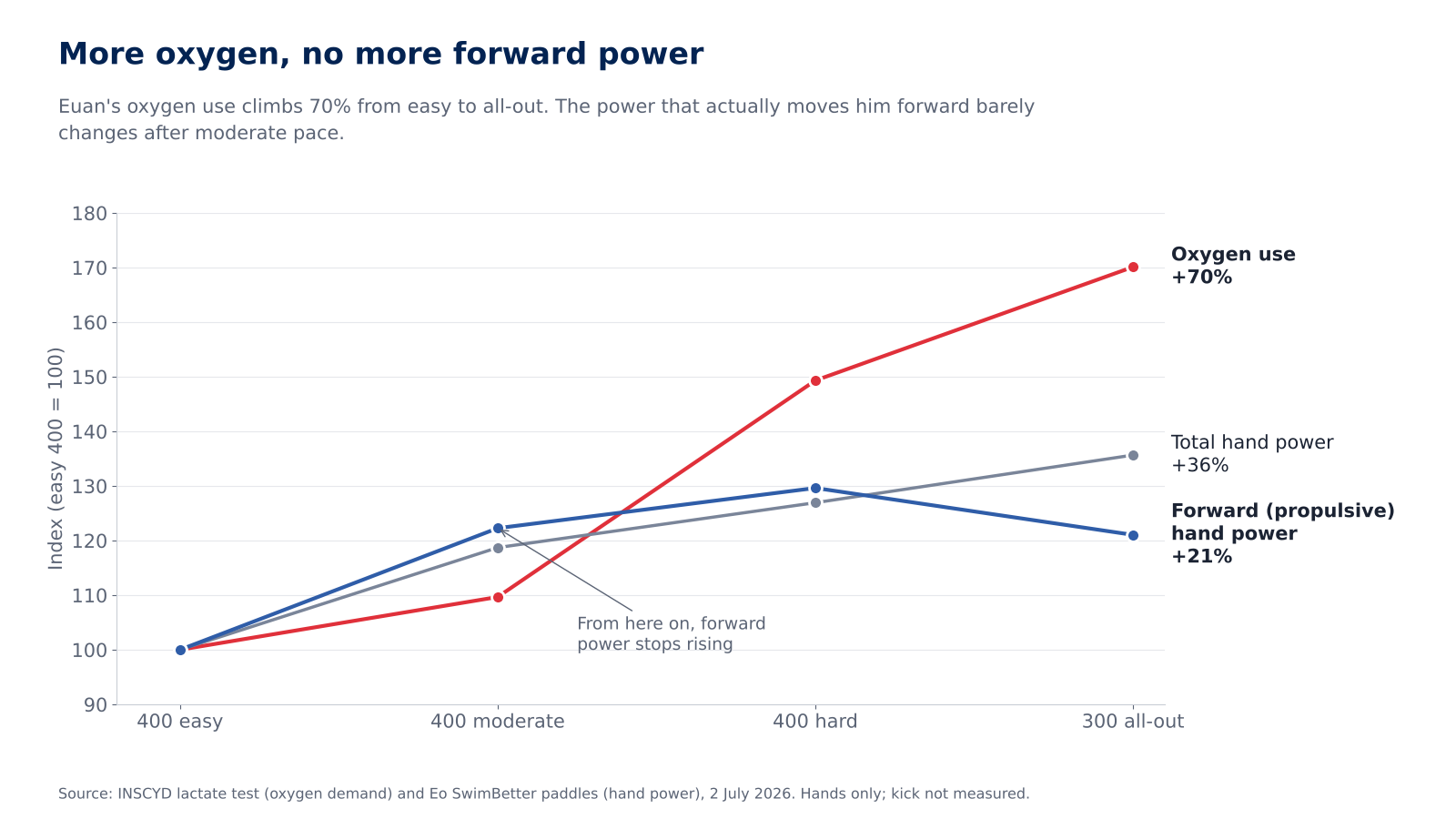
Across the four efforts, Euan's total hand power rose from 30 W to 41 W. But the share of it pushing him forward never got above about 36%. (Eo measures the hands only, so kick isn't included.)
1. Much more oxygen, no more forward hand power
This is the key finding when you put both data sets together.
From the moderate 400 to the all-out 300, Euan's oxygen use went up 55%. The forward power from his hands didn't go up at all: 13.0 W, then 13.7 W, then 12.8 W. The extra effort went into pushing water down and sideways, not back.
2. Half his effort is pushing water down
The Eo Force Field chart breaks down where every watt from the hand goes. For Euan, the biggest share isn't forward. It's downward.
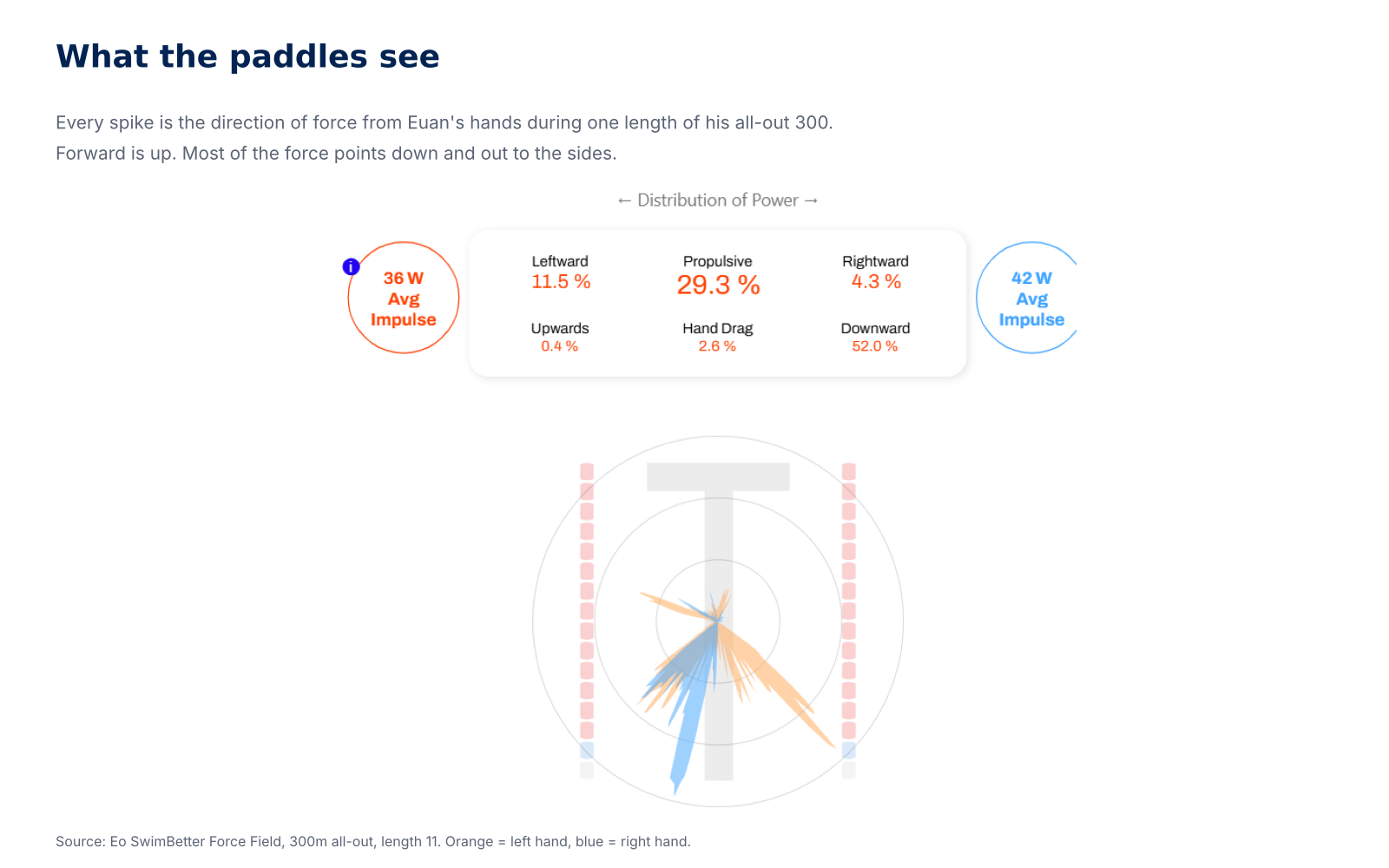
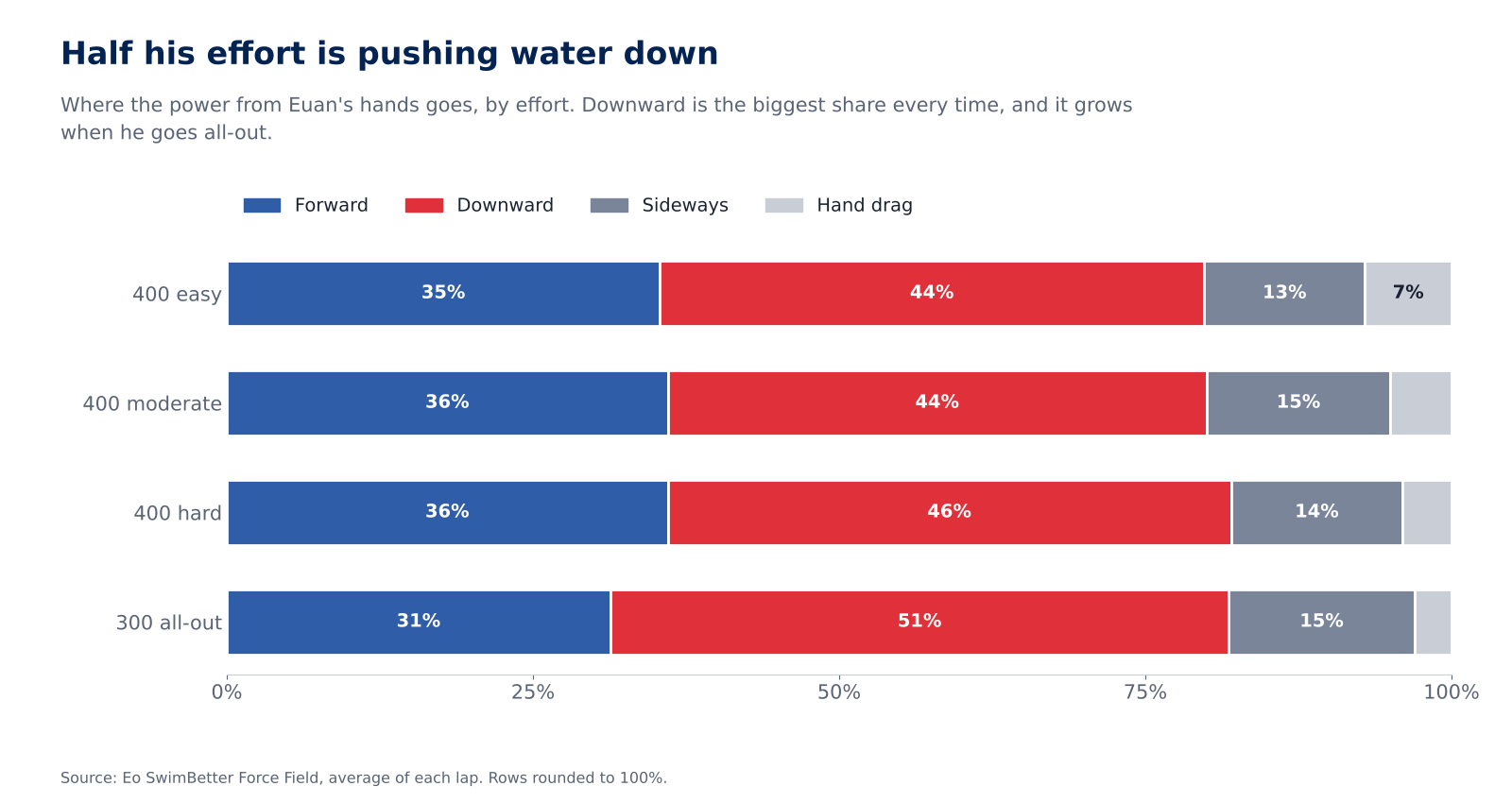
By the end of the all-out 300, 51% of his hand power was going downward. Pushing down mostly lifts the body or holds it up. It doesn't drive him down the pool. That usually means the hand is pressing down at the front of the stroke, instead of setting an early catch and pushing back.
3. The left arm falls apart under pressure
At easy pace, Euan's two arms share the work about evenly. As the pace goes up, they split apart.
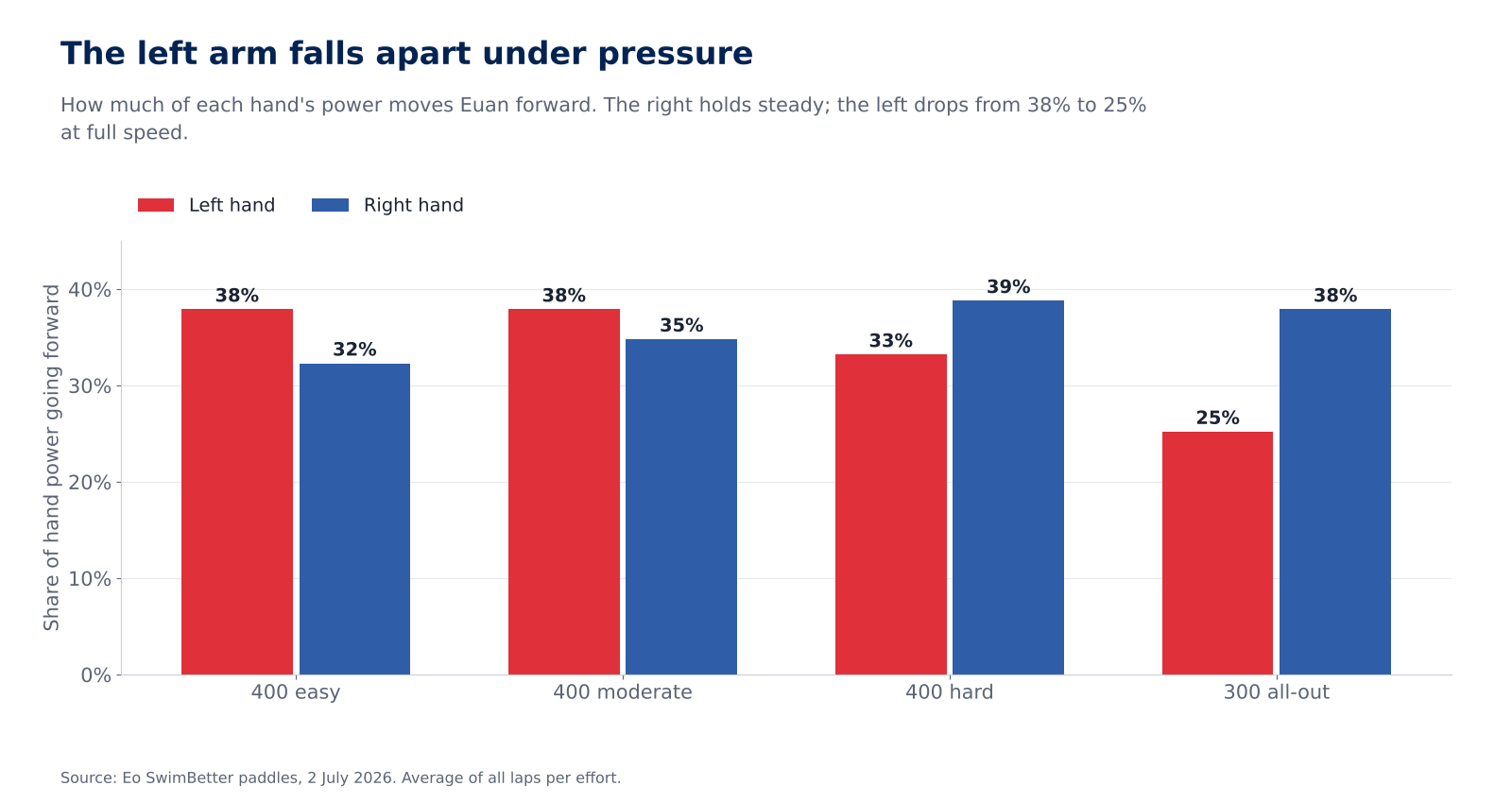
In the all-out 300, Euan's left hand was producing more total power than at easy pace, yet less forward power. By the last four lengths, only about 23% of his left hand's effort was moving him forward. Most of his sideways force goes to the left too.
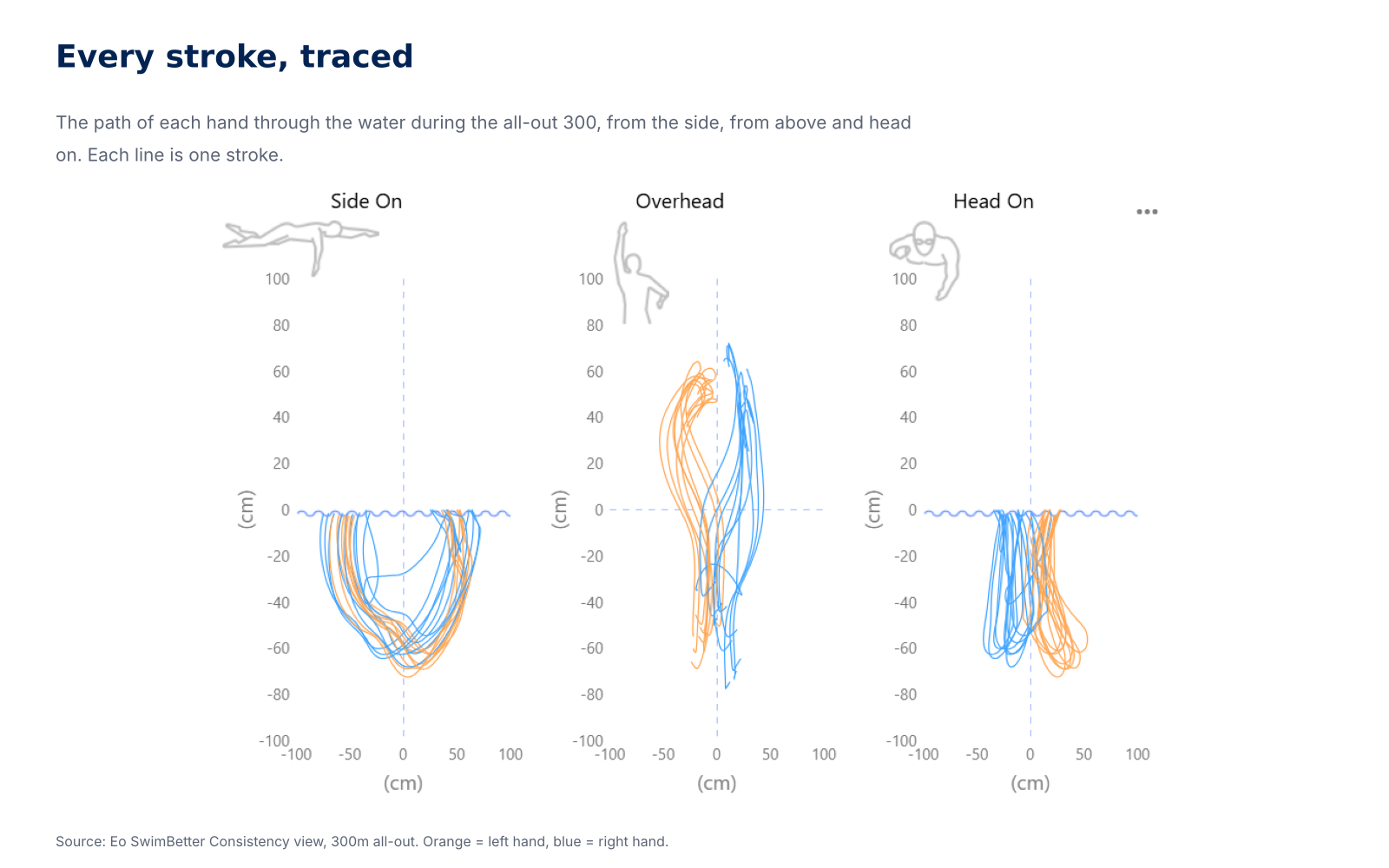
You can see the difference between his two hands in the stroke tracings from the paddles. This is the clearest single thing to fix, and the first thing we'll look at on underwater video.
4. Speed comes from turnover, not from a better stroke
From easy to all-out, Euan got about 29% faster. But he did it by turning his arms over much quicker, not by holding more water. Each stroke moved him less far.
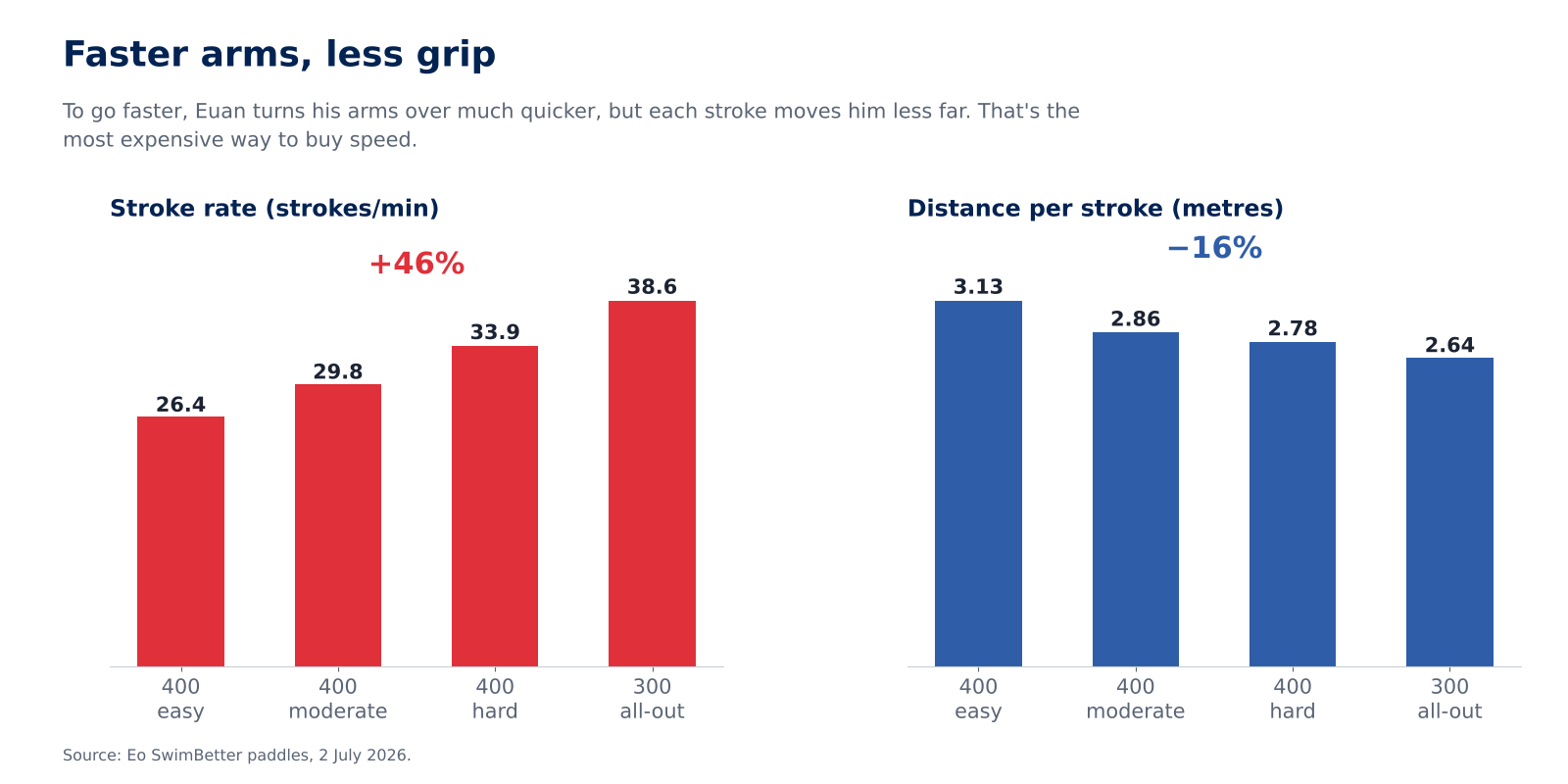
That's the most expensive way to buy speed, and it lines up with the jump in oxygen cost per metre. If the hands aren't producing more forward force at the top end, the extra speed has to come from a faster turnover, a harder kick and stronger push-offs, and the kick is a very oxygen-hungry way to go faster.
5. It fades within every effort
Forward hand power drops by 16 to 17% from the early lengths to the final four of his hard 400 and all-out 300. As he tires, the stroke slips further towards pushing down and out to the side.
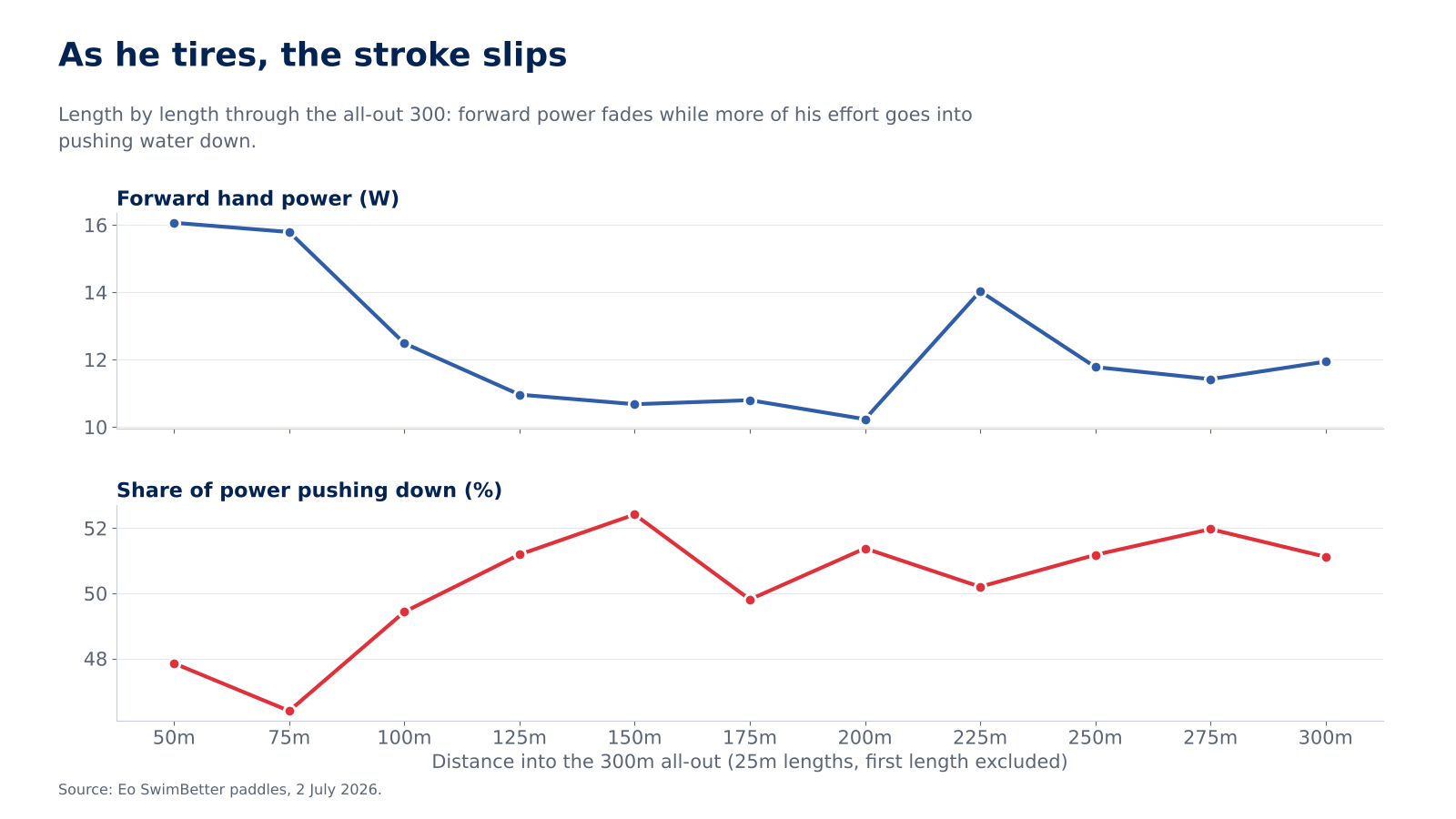
In a long race, or in open water where there are no walls to push off and reset, that slow leak adds up.
Why fitness isn't the answer
Put it all together:
His engine is close to maxed out: VO2 max 77, and threshold already at 90% of it.
His delivery is leaky: only about a third of his hand power goes forward.
It gets worse when it matters: as he speeds up and as he tires, which is exactly when an elite race is decided.
Economy is the bigger lever, and it's the more achievable one. Adding to an already elite VO2 max is a big ask. Getting back some of the 64% of hand power that isn't pushing him forward is a technique problem we can work on.
VLamax is a trade-off. Raising it helps short, fast efforts but costs him over longer distances, because a higher glycolytic rate lowers his threshold and burns carbohydrate faster. That's why the sprint work below is a small, targeted dose and not a priority.
The engine vs the drivetrain
Think of a car with a huge engine and wheels that spin on a wet road. Pressing the accelerator harder makes more noise and smoke, but not much more speed. Euan is that car. Adding horsepower won't help much. Getting more grip, so more of his hand force goes backward, will.
The plan: economy first
For Euan, the main goal isn't to make him fitter. It's to make him more economical, especially at faster paces, so that more of the engine he already has goes into swimming faster.
Fixing the downward press
The biggest single leak in his stroke is the downward press. At the front of the stroke his hand pushes down on the water instead of setting up to push back, and by the end of a hard effort about half his hand power is going downward.
So the technical work starts there:
Set the catch up properly. Instead of pressing down after the hand enters, he needs to get his forearm and hand facing backwards early, so the force he produces is directed back down the pool.
Then build power from that position. Once the catch is set, the pull can generate force that actually moves him forward. That's what makes him more economical.
Fix the left arm. At speed his left hand drops to 25% propulsive, against 38% on the right. Much of the downward and sideways leak comes from that side.
The aim isn't to produce more power. It's to direct the power he already makes. If more of each stroke goes backward, each metre costs less oxygen. Then the same engine carries him faster, and at race pace he's further from his ceiling.
Why we're careful with hard intervals
This is where Euan's plan differs from what a lot of swimmers would be given.
The usual answer to "get faster" is lots of hard repeats: sets of fast 100s, 200s or 400s that push towards VO2 max. For a swimmer with an efficient stroke, that works well. For Euan, it can backfire.
Because his stroke is uneconomical, he reaches VO2 max at slower speeds than an efficient swimmer would. In the test, the hard 400 already had him at 86% of VO2 max, and the all-out 300 at 98%. Once he's that close to his ceiling, fatigue builds quickly. As he tires, the data shows his stroke falling apart in exactly the ways we're trying to fix: more downward press (up to 51%), a weaker left arm, and a faster, shorter stroke.
So a set of hard VO2 max reps becomes hundreds of practice strokes of the pattern we want to get rid of. He gets tired, his form gets scrappy, and the bad technique gets more ingrained.
Instead, the faster work in his week looks like this:
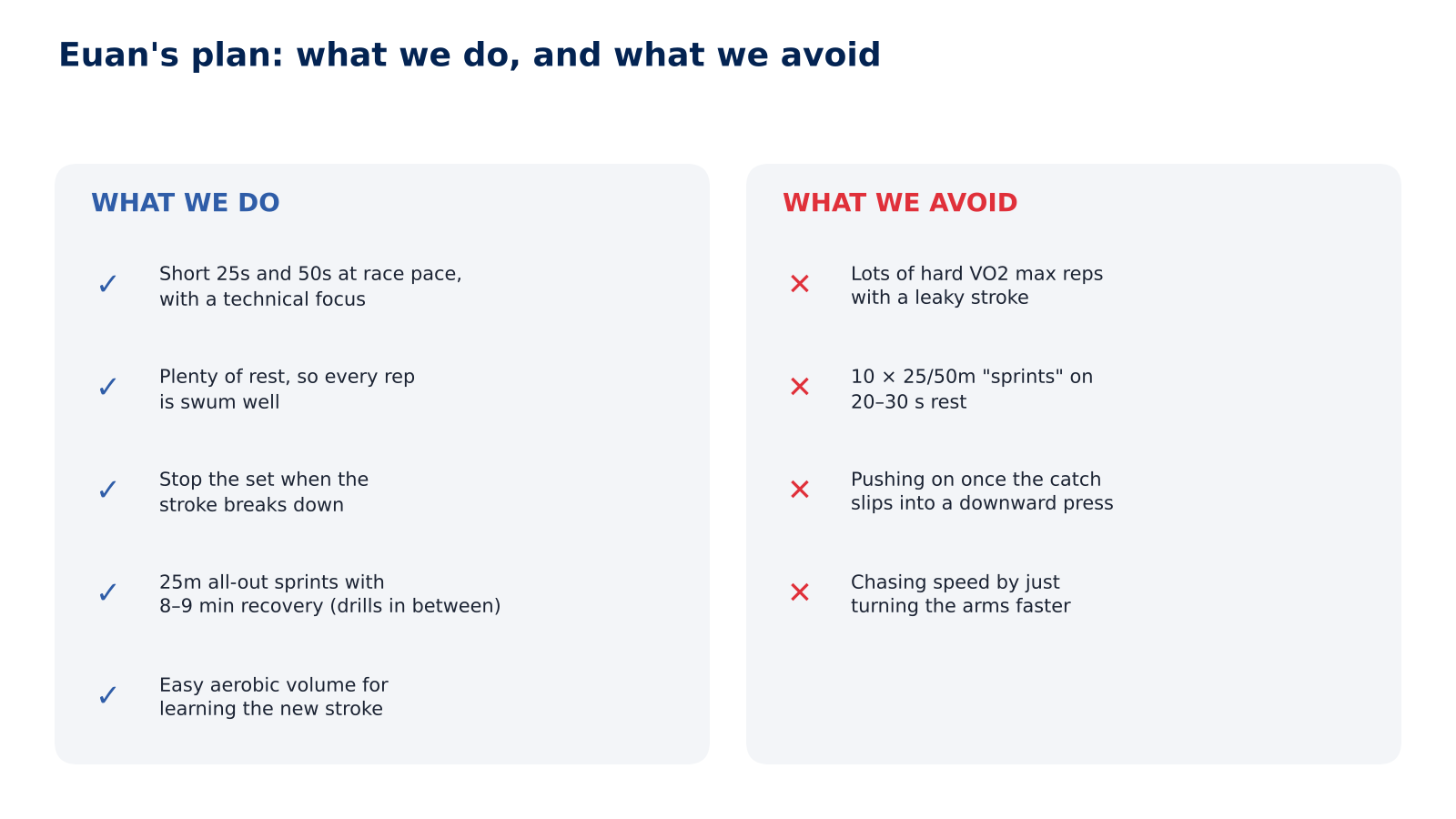
Mostly short reps with a technical focus. These are 25s and 50s at or near race pace, with enough rest that he can hold his stroke on every one. The aim of each rep is to swim fast well.
Stop when the stroke goes. If the catch starts slipping back into a downward press, the set has done its job. Pushing on past that point just trains the leak.
Lots of easier aerobic swimming. His base zone from the test is 1:16 to 1:17 per 100m, and recovery is slower than 1:28. This is where new movement patterns get learned, because he isn't fighting fatigue.
Only enough VO2 max work to hold the engine. His aerobic capacity is already elite, and we don't want to lose it while the stroke changes. So a small, controlled amount of work at his VO2 max pace (1:07 to 1:13 per 100m) stays in. It's there for maintenance, not as the main driver.
As the stroke improves, he'll be able to hold good technique at faster speeds for longer, and we can gradually extend the faster work. Pace builds on top of good technique, not the other way round.
A small dose of real sprinting
There's a second, smaller piece to Euan's plan, separate from the technique work. His glycolytic power, his ability to produce energy fast, is low. His VLamax is 0.32 mmol/L/s, and even flat out in the 300 his lactate only reached 5.2 mmol/L.
That's partly why his threshold is so close to his VO2 max. A low glycolytic ceiling means he doesn't burn through carbohydrate quickly at hard paces. But it also limits how well he handles fast race starts and short, hard surges, which matter a lot in a draft-legal swim start.
So there's a case for nudging his VLamax up slightly, without eroding his threshold. That means real, top-end neuromuscular sprinting:
25m genuinely all-out. It needs to be a true maximal effort to send a strong signal to the glycolytic system to upregulate.
Hold some form. Even at maximum speed, he should try to keep the catch set up and avoid pressing down. These are fast swims, not scrappy ones.
Long recoveries. He gets 8 to 9 minutes between efforts, so every sprint is high quality.
Recovery isn't wasted. During those 8 to 9 minutes, Euan does drills and technique work. The sprints and the economy work can sit in the same session.
Why a typical sprint set doesn't suit him
Many squad programmes use sets like 10 × 25m or 10 × 50m fast, with 20 to 30 seconds' rest. For plenty of swimmers that's a useful set. For Euan, it probably isn't.
With only 20 to 30 seconds between reps, they aren't really sprints. After the first few, he isn't recovered enough to go truly all-out, so the set doesn't send the top-end signal we want. It turns into a set of fast, fatigued swimming instead, which is the exact situation where his stroke breaks down. Every rep is practice at swimming fast with a downward press and a collapsing left arm.
We can't say that sets like this caused his stroke to degrade at speed. But repeating them would likely make it harder to fix, and it may be part of why his form falls apart as he speeds up.
The real lesson: understand the athlete first
None of this means hard intervals are bad, or that squad sprint sets are wrong. They're the right tool for a lot of swimmers.
The point is that Euan's limiter isn't the same as everyone else's. His engine is already elite. What holds him back is how much of that engine reaches the water, and the more he's pushed to swim harder and faster with his current stroke, the more of it he wastes.
If we'd looked at his race times and simply prescribed more hard work, we'd likely have made him more tired, reinforced the stroke flaws, and seen little improvement. Testing him properly showed us what actually drives his performance:
Economy first. Fix the downward press and set up a catch that sends power backward.
Short, technical speed work. Fast swimming he can do well, not hard swimming he does badly.
A small dose of real sprinting. Short, all-out and properly recovered.
Just enough high-end aerobic work to hold his engine.
That's what our full testing suite is for. Knowing the athlete's physiology, knowing their economy, and knowing where their propulsive power actually goes gives us the complete picture. Once we have that, we know exactly which way to focus.
For some athletes, economy is already good and VO2 max is the limiting factor. For them, training becomes the key, and harder, well-targeted sessions are exactly what they need. In Euan's case, it's all about improving his economy.
Better swimming doesn't come from swimming harder. It comes from knowing which lever actually moves the athlete in front of you, and pulling that one.
How we'll know it's working
We'll repeat the same INSCYD test on the Eo paddles and track:
Oxygen cost per metre at hard pace. Baseline 0.83 ml/kg/m (400m #3) and 0.88 ml/kg/m (300 all-out).
Threshold pace (MLSS). Baseline 1:12.6 per 100m. If economy improves, this should get faster even if VO2 max doesn't change.
Propulsive % at hard pace. Baseline 36.0% on the hard 400 and 31.5% on the all-out 300.
Downward share at all-out pace. Baseline 50%.
Left-hand propulsive % at all-out pace. Baseline 25% (right: 38%).
Distance per stroke at hard pace. Baseline 2.78 m at 33.9 strokes/min.
Race times over longer distances. Especially long course and open water, where holding the stroke together matters most.
If they move the right way, Euan will swim faster at the same effort, or hold the same pace at a lower cost. Either way, he has more in reserve for the parts of a race that matter.
What this means for your swimming
You don't need a VO2 max of 77 for Euan's story to apply to you. If any of these sound familiar, efficiency may be your limiter too:
You can swim steadily for a long time, but you fall apart when you try to go faster.
You're training hard, doing all the hard sets, but your times have stalled.
You get out of the water in a triathlon feeling more tired than your fitness suggests you should.
To go faster, you mostly just spin your arms quicker.
More fitness won't fix a en inefficient stroke. Measuring how much of your effort actually moves you forward is the fastest way to find out where your time is going.
Want to know how efficient your swimming really is? Our swim testing gives you the full suite: lactate and VO2 testing to map your physiology and energy systems, economy to show what each speed costs you, and Eo propulsion analysis to show where your power actually goes. Together they tell us whether your limiter is your engine or your efficiency, and give you a clear plan to fix it. Book a swim analysis session or call us on 01224 900500.