

Swim performance profile · INSCYD swim testing + EO SwimBETTER
What’s stopping you swimming faster?
Two swimmers can hold the same pace for completely different reasons. We combine INSCYD metabolic swim testing with EO SwimBETTER force data to find exactly what’s limiting each swimmer, and the exact training that will fix it.
VO2max · Lactate & threshold pace · Economy · Force data · Your exact training prescription
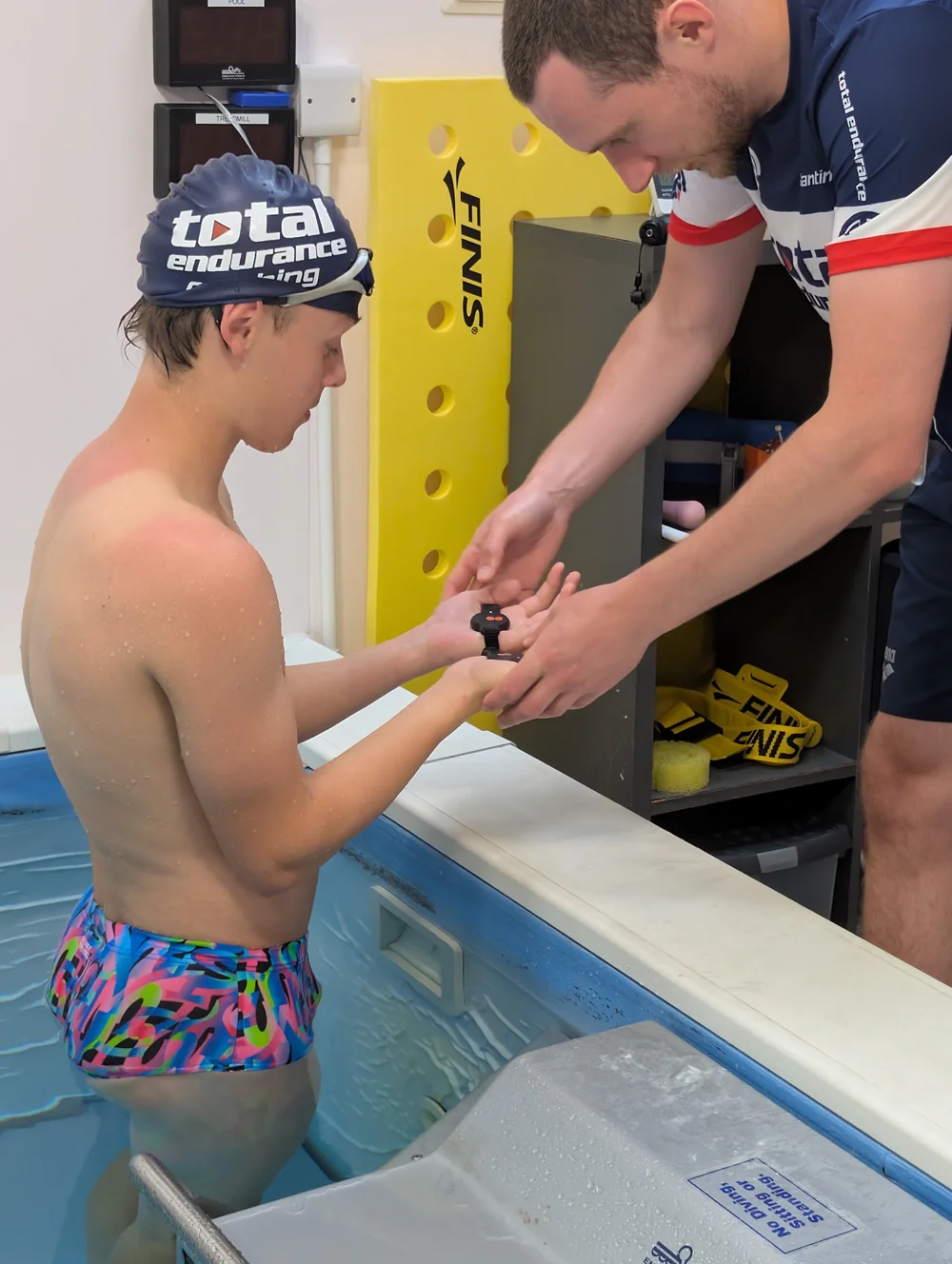
You can hold a pace. So what’s holding you there?
Most swimmers and coaches answer this by guessing. The answer is usually one of four things, and each needs a completely different kind of training.
Is the aerobic engine too small? Then you need sets that build maximal aerobic power.
Is threshold pace too slow for your engine? Then you need threshold work set from your own lactate profile.
Is there no top end for 50–200 m racing? Then you need sprint and glycolytic sets, done the right way.
Does every metre cost too much energy? Then the fix is technique, and EO data shows exactly where force is lost.
Train the wrong one and you can work hard all season without getting faster. A swim performance profile tells you which one it is.
Physiology + technique = the complete swimmer
Metabolic testing shows what your body can produce. EO force data shows how much of it actually moves you forward. Most testing gives you one side of the picture. We give you both, in one diagnosis.
Your engine
- VO2max: your aerobic ceiling
- VLamax: your sprint and lactate power
- Threshold (MLSS) pace per 100 m
- Swim economy: energy cost per metre
- Fat and carbohydrate use at every pace
Your stroke
- Where every stroke gains or loses force
- Propulsive vs wasted downward and sideways force
- Left/right balance and catch efficiency
- Mid-pull stalls and hand drag
- The technique fix that saves the most energy
Your plan
- Your main limiter, ranked
- The events and distances you’re built for
- Training paces and zones from your own threshold
- Interval distances and recovery you need
- Technique priorities with drills
Answers, not just numbers
What’s limiting you
VO2max, lactate, speed or economy, ranked by how much each one is costing you.
Your best events
Whether your profile suits sprint, middle distance or distance, and how to train for the events you want to race.
Your training paces
Zones set from your own threshold per 100 m, so every set hits the intensity it was meant to.
Distances and recovery
How long your intervals should be, how much rest you need, and whether to recover actively or rest fully.
Where force is lost
EO data shows exactly where your stroke leaks propulsion, and the drills that fix it.
Where your fitness is now
A baseline you can re-test against, so you and your coach can see what the training has changed.
Six swimmers. One set. Six different workouts.
We tested six university and club swimmers. Then we looked at what a typical set of 100 m repeats at 1:10 per 100 m actually did to each of them. Same pace on the whiteboard, very different sessions in the water.
100 m repeats at 1:10/100 m
Bar = that pace as a percentage of each swimmer’s threshold (MLSS) pace. Past the dashed line, the set is above threshold.
Easy aerobic
Steady aerobic
Steady aerobic
Steady aerobic
Above threshold, 94% VO2max
Above threshold
Fastest threshold in the group and a big aerobic engine. Built for 400 m and up. For 100–200 m, add speed work to build top-end power.
Biggest engine in the squad, but the highest energy cost per metre. Technique is the fastest route to speed, not more fitness.
Very aerobic profile that already works close to its ceiling at threshold. Raising VO2max is the lever for a faster threshold pace.
Works far harder than the group at shared paces. Set their sessions from their own threshold, then build VO2max and economy.
Highest lactate power in the squad. A natural sprinter: protect the speed for 50–100 m, or add aerobic volume to move up in distance.
The most efficient swimmer by far, holding a quick threshold from the smallest engine. VO2max sets will give the biggest gains.
Swimmer B: the biggest engine, losing it in the water
Swimmer B had the highest VO2max in the squad but the poorest economy. Physiology told us that energy was being wasted. The EO paddles showed us where.
Only half of their force drove them forward. A third pushed water down. That points to a specific catch and elbow position fix, so the engine they already have turns into speed.
Dashed lines show the targets for distance freestyle: 70% forward, under 22% downward, under 8% sideways.
Real results from a university and club squad testing session, shared anonymously. Threshold = maximal lactate steady state (MLSS) pace per 100 m.
Swimmer D: from test data to training plan
Remember Swimmer D, working above threshold on the squad’s 1:10 set? Here’s what their INSCYD swim test showed, and how it turns into sessions.
The step test
Three progressive swims, then a maximal effort. We measure oxygen uptake and blood lactate at each step.
Threshold sets
Swim them at 1:12–1:13, not the squad’s 1:10. That’s the pace that actually builds lactate clearance.
Recovery
At 1:10 they’re above threshold, so lactate builds every rep. On those sets they need more rest than the lane.
The priority
Raise VO2max with short, hard aerobic sets, so the same threshold costs a smaller share of the engine.
The technique
EO data shows where force is lost, so better economy turns the same fitness into a faster pace.
Is the swimmer built for their event, and are they resting right?
VLamax is how fast a swimmer produces energy from carbohydrate, and with it, lactate. Sprinters need it high for top-end speed. Distance swimmers need it lower so they burn less carbohydrate and hold a faster threshold. Knowing it tells coaches whether a swimmer’s engine suits their event, and exactly how to structure rest in every set.
Squad VLamax: who’s built for what
mmol/l/s, from the same squad testing session.
The right work:rest ratio
A high-VLamax swimmer makes lactate quickly and needs longer to clear it. A low-VLamax swimmer clears it faster and copes with shorter rest. The data gives each swimmer their own ratio, not one interval for the whole lane.
Active recovery or full rest?
Easy swimming at the right pace clears lactate fastest, ideal between threshold and VO2max reps. True sprint work needs passive rest so the fast-twitch energy system fully recharges. We give you the recovery pace for each swimmer.
How long after each effort
The profile shows how quickly each swimmer clears lactate after a hard effort, so coaches know how much rest is needed before the next rep is swum at full quality.
Get the rest wrong and you change the session
If a sprinter starts the next rep before they’ve recovered, they can’t reach top speed. The set quietly turns into VO2max or lactate tolerance work: hard, but training a different system and producing a different result. VLamax data protects the purpose of every set.
Every rep at top speed. Builds sprint power, as planned.
Speed fades rep by rep. Lactate stacks up. Not the session the coach wrote.
From test swims to training plan
It’s the same INSCYD approach behind our marathon and 70.3 testing, built specifically for swimmers.
Metabolic test swims
A short series of progressive swims while we measure oxygen use and lactate.
EO force capture
A swim with the EO paddles and video to record where every stroke’s force goes.
INSCYD analysis
Your VO2max, VLamax, threshold pace, economy and fuel use, modelled together.
Your profile report
Your limiter, best events, training zones, interval and recovery prescription, and technique fixes.
Debrief & re-test
We walk you or your coach through it, then re-test to measure what’s changed.
For swimmers, triathletes and the coaches who train them
Individual swimmers & triathletes
Find out exactly what’s stopping you getting faster, get training paces built from your own physiology, and take a clear plan back to your squad or coach.
Contact us to discussClubs & squads
Profile your whole squad and give your coaches each swimmer’s limiter, training zones and technique priorities, so one session plan works for everyone in the lane.
See club optionsBefore you book
What is INSCYD testing?
INSCYD is a metabolic profiling system that works out your VO2max, VLamax (your lactate and sprint power), threshold pace, economy and how you use fat and carbohydrate. From these we can prescribe exactly what training you need, rather than guessing.
What’s the difference between VO2max and VLamax?
VO2max is the size of your aerobic engine. VLamax is how quickly you can produce energy from carbohydrate, which drives sprint speed but also affects your threshold. The balance between the two decides which events suit you and how you should train.
Is this the same as your marathon and 70.3 testing?
It uses the same INSCYD approach, but the test is done in the water and built around swimming, so your paces and zones are per 100 m and specific to your stroke.
Why does VLamax matter for recovery?
VLamax shows how quickly a swimmer produces lactate. It tells coaches how much rest each swimmer needs, whether active recovery or passive rest gives the better training effect, and stops a sprint set turning into a VO2max set because the rest was too short.
Why add the EO paddles?
Physiology tells you how much energy you’re using. EO force data shows where it’s going. If economy is your limiter, the EO data pinpoints the technique fault, so you know exactly what to fix.
Can my coach use the results?
Yes. The report is written so your coach can use your training zones, interval prescription and technique priorities straight away. We’re happy to talk your coach through it.
How often should I re-test?
Most swimmers re-test every 8–12 weeks, or at the start of each training block, to check the training is working and update their paces.